World Cup Fever Is Here! Choose your broker like you choose your team
Join WikiFX and investors worldwide in celebrating the excitement of the 2026 FIFA World Cup!
简体中文
繁體中文
English
Pусский
日本語
ภาษาไทย
Tiếng Việt
Bahasa Indonesia
Español
हिन्दी
Filippiiniläinen
Français
Deutsch
Português
Türkçe
한국어
العربية
اردو
Abstract:Japan and Hong Kong led a jump in regional stocks on Thursday, joining a rally on Wall Street overnight as potential risks from Federal Reserve monetary tightening to the Ukraine war and a slowdown in China became less murky.
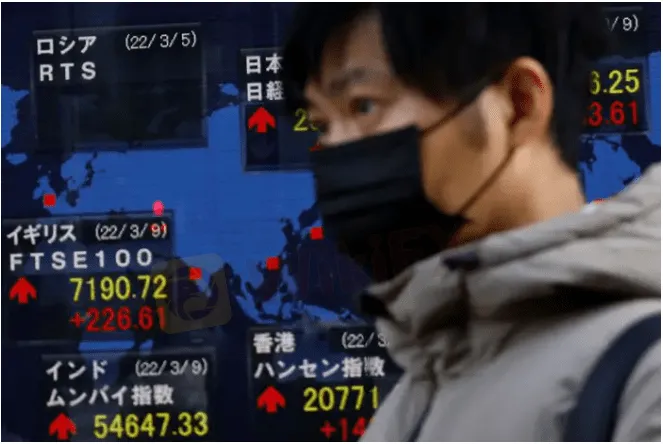
Wall Street stocks rebounded from early session losses on Thursday as investors weighed economic implications of the Federal Reserves surprisingly aggressive interest rate stance, while oil prices surged on supply shortage concerns arising from the Russia-Ukraine conflict.
The Fed announced a quarter of a percentage point increase to near-zero interest rates on Wednesday, its first hike in nearly three years as it sought to combat soaring prices. The U.S. central bank also projected six more similarly sized rate hikes this year, sparking worries among traders about the effect on economic growth.
U.S. Treasury yields held just below three-year highs on Thursday and the closely-watched yield curve steepened, after earlier sitting at its flattest level in more than two years.
Benchmark 10- and 2-year yields were last at 2.1653% and 1.969%, respectively.
“The big surprise yesterday was the dot plot,” said Thomas Hayes, chairman at Great Hill Capital in New York, referring to the Feds interest rate projections.
“It was a dovish hike but a hawkish rhetoric and outlook. We believe that if they get anywhere near their projections theyd invert the yield curve and cause a guaranteed recession.”
On Wall Street, the three main indexes reversed early losses, driven by the healthcare, consumer discretionary, technology, and financial sectors.
The Dow Jones Industrial Average rose 1.23%, to 34,480.76, the S&P 500 gained 1.23% to 4,411.67 and the Nasdaq Composite added 1.33% to 13,614.78.
“We had a relief rally yesterday and the market is digesting that today, consolidating a little bit and trying to get comfort with the reality versus expectations in terms of what the Fed is projecting,” Hayes added.
European stocks also gained in choppy trading following the Fed rate hike and a similar move by the Bank of England.
The pan-European STOXX 600 index rose 0.45%, while MSCIs gauge of stocks across the globe gained 1.77%.
Oil prices rose more than 8%, continuing a series of wild daily swings, as the market rebounded from several days of losses on renewed focus on supply shortages in coming weeks due to sanctions on Russia.
Benchmark Brent crude futures settled 8.79% higher at $106.64 a barrel, its highest percentage gain since mid-2020.
U.S. West Texas Intermediate (WTI) crude rose 8.35% to $102.98 a barrel.
The dollar index, which measures the greenbacks strength against six trading currencies, was last down 0.47% at 98.026.
Gold rose 1% as the U.S. dollar and Treasury yields retreated. Spot gold added 0.7% to $1,942.04 an ounce, while U.S. gold futures gained 1.62% to $1,939.00 an ounce.


Disclaimer:
The views in this article only represent the author's personal views, and do not constitute investment advice on this platform. This platform does not guarantee the accuracy, completeness and timeliness of the information in the article, and will not be liable for any loss caused by the use of or reliance on the information in the article.

Join WikiFX and investors worldwide in celebrating the excitement of the 2026 FIFA World Cup!

Have you experienced issues with Pepperstone deposit & withdrawal processing? From your experience, do you feel that the Australia-based forex broker causes losses to its clients? Did the brokerage entity freeze your account and give you a margin call? All these trading allegations have been rampant on broker review platforms such as WikiFX. This Pepperstone review article takes a close look at the user complaints, especially in 2026. Additionally, we have given an overview of the regulatory framework under which the brokerage entity operates.

Some broker comparisons end with a confident "go with this one." This is not one of them — and that honesty is exactly what makes it worth reading. Wundersys and tradgrip are two young, offshore-registered brokers that keep popping up in front of beginner traders, often through aggressive online marketing. Both promise the usual buffet: tight spreads, generous leverage, multiple account tiers. And both, according to WikiFX, sit near the very bottom of the safety scale. So instead of crowning a champion, this comparison is really about something more useful: learning to read the warning signs, understanding the small differences that still matter, and knowing why "the better of two risky options" is still a conversation about risk.

If you trade forex from India, Pakistan, Bangladesh, Sri Lanka, or Nepal, you already know the quiet truth that eats into every trader's results: it is not just the market that decides whether you profit — it is the cost of getting in and out of each trade. Shave a couple of dollars off your commission on every lot, multiply it across hundreds of trades a year, and you are looking at the difference between a strategy that works and one that bleeds out slowly. South Asian traders are some of the most cost-conscious in the world, and rightly so. So we pulled the data on the brokers most often recommended for the region, cross-checked every name on WikiFX, and ranked them by the one number that matters most here: what they actually charge you to trade. Before the list, one quick lesson that will make this whole ranking click.