Abstract:DeFi leaders Opyn, ZeroEx, and Deridex face CFTC enforcement actions for various violations, highlighting regulatory scrutiny in the decentralized finance realm. Stay informed with the latest in forex through the WikiFX App.
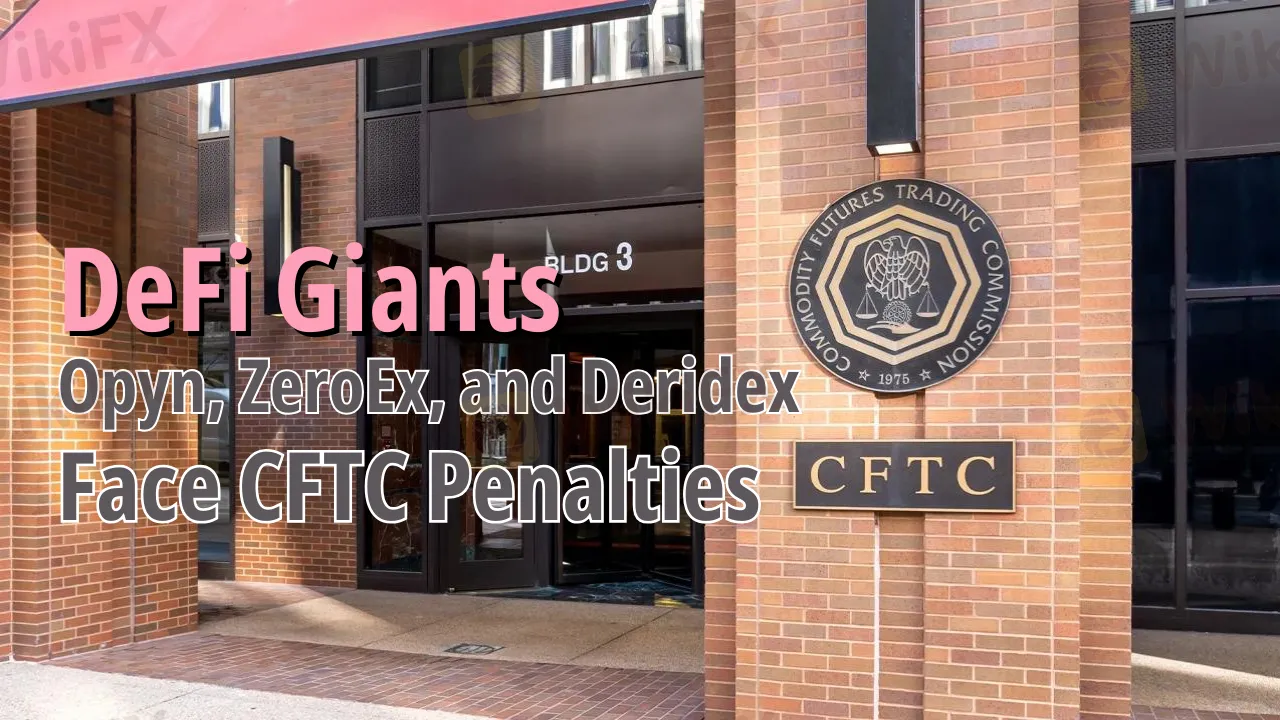
In the ever-evolving world of decentralized finance (DeFi), three major players - Opyn, ZeroEx, and Deridex - have recently been handed enforcement actions by the Commodity Futures Trading Commission (CFTC). These companies have been charged with several violations, emphasizing the CFTC's continuous scrutiny of the DeFi landscape.
 Contents
The Charges and Penalties
Both Deridex and Opyn are facing penalties for failing to register as a swap execution facility (SEF) or designated contract market (DCM). Furthermore, they were charged for not adopting a customer identification program, which is part of the Bank Secrecy Act compliance program for futures commission merchants (FCMs). ZeroEx, alongside the other two, also faces charges for unlawfully offering leveraged and margined retail commodity transactions in digital assets.

As a consequence, the three firms have been mandated to pay civil monetary penalties. Opyn is set to pay $250,000, ZeroEx will pay $200,000, and Deridex owes $100,000. They are also mandated to halt any violations of the Commodity Exchange Act (CEA) and CFTC regulations.
Deep Dive: The Companies and Their Operations
Opyn, Inc. had launched the Opyn Protocol which facilitated the trading of a digital asset derivative token called oSQTH. This token's value was pegged to an index (Squeeth) that tracked the square of ether's price relative to the USDC stablecoin. The issue arose when it was determined that these tokens acted as swaps and leveraged retail commodity transactions. The CFTC stated that such transactions can only be presented to retail users through a registered exchange. Opyn also did not sufficiently block U.S. users from accessing its protocol.

Deridex, Inc. operated a blockchain-based protocol offering “perpetual contracts.” These contracts can be termed as swaps and, similar to Opyn's issue, must only be offered on a registered exchange. Deridex also took no precautions to exclude U.S. citizens from accessing its protocol.

ZeroEx Inc. on the other hand, introduced a protocol and a front-end application (Matcha) that allowed users to trade digital assets on multiple blockchains. Some of these digital assets provided traders with approximately 2:1 leveraged exposure to renowned digital assets like ether and bitcoin. This was in direct violation of CFTC regulations.

Bright Side of Cooperation
Despite the hefty penalties, the CFTC acknowledged the cooperation extended by all three companies during the Division of Enforcement's investigation. This proactive stance from the firms resulted in a reduction of their respective civil monetary penalties.
For those keen on staying updated with the latest happenings in the forex market, consider installing the WikiFX App. With the DeFi landscape continuously evolving, it's essential to remain informed, ensuring that both investments and operations align with regulatory requirements.
Download the App here: https://www.wikifx.com/en/download.html