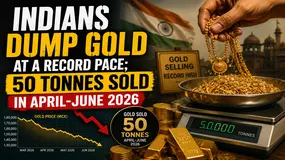
Abstract:Want to know why gold prices differ from one place to another in India? It's because of these top reasons. Read this interesting gold story.

Gold and Indians are a pair made in heaven. Indians dont just buy gold, they are emotionally invested in it. Whenever one thinks of marriage or festivals in India, the first thing that comes to mind is gold and the ornaments made from it. So that the experience magnifies with added joy.
For record books, India is the largest gold jewellery consumer. In 2024, India‘s gold jewelry consumption was 563.4 tons. At the same time, the country’s demand for gold grew 5% annually to 802.8 tons in 2024, rising from 761 tons in 2023.
So, when the gold price in India goes up, the heart beats up for those who have bought gold and those who are yet to buy. Those who already have gold would enjoy its high market value. Those who have not would like to purchase before it rises further, making it difficult to buy the required quantities. Thats why many people search for the gold rate in India today when surfing online.
Over the last five years, the gold price in India has constantly grown. Of course, the global uncertainty owing to geopolitical wars that took place helped its rally too.
However, the gold price chart is not dictated by just geopolitical wars. There are many other factors that weigh in on price determination. Lets check out all the factors that help determine the price of the yellow metal in India.
Examining the Factors That Help Determine the Gold Price in India
Inflation Rate
The gold rate in India is determined heavily by the inflation rate that exists in India. If the inflation rate goes up, gold prices also jump. The increased gold price demonstrates high demand for the yellow metal.
Gold Reserves
Like most central banks across regions, the Reserve Bank of India (RBI) maintains gold reserves as a hedge against market uncertainty. If it preserves gold, the supply of the yellow metal will decrease, leading to a rise in prices.
Wedding & Festive Season
Weddings and festivals also play a vital role in determining the gold price in India. Since gold is used extensively for both these purposes, the demand for the yellow metal remains high when these events occur. The increased demand thus leads to higher prices.
Industrial Demand
Gold is extensively used to make jewelry. But do you know it is also used in the electronics manufacturing industry? The yellow metal is used as a component in televisions, computers, mobile phones, etc. If the demand for gold rises in this industry, its price in the open market will rise further.
Production Overheads
The policy changes in the gold mining companies also dictate the gold price in India. If these companies decide to hike the manufacturing cost, the prices will increase.
State Laws
In India, each state has specific rules and regulations. These regulations help determine the gold price in that particular state. So, the gold rate today in Mumbai may not be the same as in other cities across different states. The variation in taxes across states makes prices different across places.
Hauling Cost
The hauling cost of gold also plays a role in determining its price in India. India is one of the leading importers of gold. The gold imported to India goes to various cities, leading to the addition of hauling costs. These costs add to the gold price in India.
US Dollar Performance
The gold price in India is also dependent on the US dollar. The price of the yellow metal moves inversely to the dollar rates. While gold is a traded commodity worldwide, the USD remains the most preferred international currency. Gold prices will move up or down regarding any changes within the US. Also, as India imports gold heavily, the international market also dictates prices.
Frequently Asked Questions on the Gold Price in India
What are the National and International Factors That Affect the Gold Price in India?
National factors impacting gold prices in India would include the inflation rate, festive season demand, production cost, etc. International factors would include the extent of imports made during the period, dollar movement, global geopolitical environment, etc.
May I Know the Various Gold Price Categories in India?
There are no specific categories. However, when you search online, prices will be shown for 1 gram, 10 grams and 100 grams of gold across 24K and 22K.
Whose Price is Greater - 24K or 22K?
24K gold price is always greater than 22K because the former is considered to have a purity of 99.9%, almost touching 100%. On the other hand, 22K contains 91.60% pure gold. The rest contains other metals.
Does the Gold Price Change Throughout the Day?
Changes happen because of the trading that takes place across the spot and futures markets.
Take a tour of our WikiFX App to know whats trending in Forex. Download it today.

Also, be part of our growing WikiFX India community on Telegram.