Abstract:Traders flock to established brokers for stability, but recent investigations into ACY Securities suggest a disturbing trend where profitability meets procedural roadblocks. Analysis of complaints from 2024 and 2025 reveals a pattern where successful withdrawals are blocked by sudden allegations of "policy violations" or retroactive fee adjustments. Is your capital protected, or is it merely permitted to exist until you try to remove it?

Traders flock to established brokers for stability, but recent investigations into ACY Securities suggest a disturbing trend where profitability meets procedural roadblocks. Analysis of complaints from 2024 and 2025 reveals a pattern where successful withdrawals are blocked by sudden allegations of “policy violations” or retroactive fee adjustments. Is your capital protected, or is it merely permitted to exist until you try to remove it?
Anonymity Disclaimer: All cases cited in this report are based on real, verified records lodged with the WikiFX Service Center. Trader identities have been anonymized to protect their privacy.
The “Coincidence” That Costs Thousands
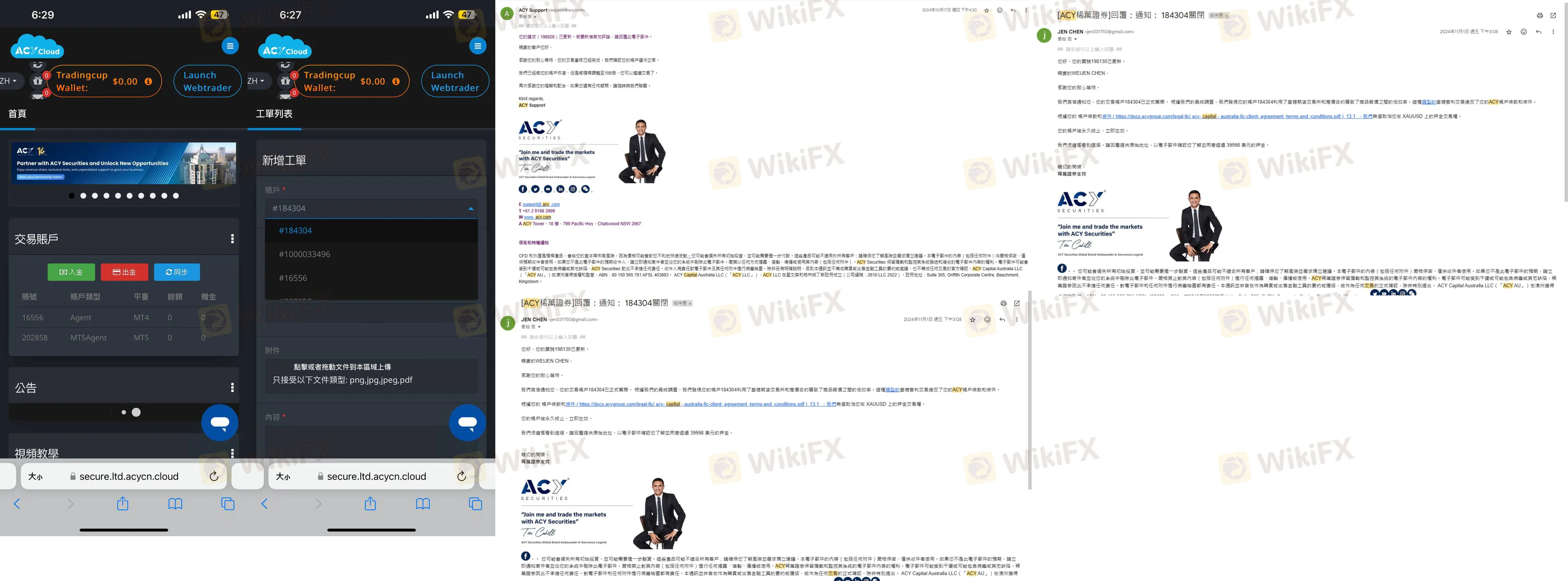
The most alarming narrative emerging from our recent data analysis involves a specific administrative tactic used to negate profits. In April 2025, a trader reported a harrowing experience after attempting to use ACY Securities as a diversification platform. After executing profitable trades, the user was suddenly informed that their trading activity violated “market depth” policies and constituted “arbitrage.”
The broker's justification was highly unusual. According to the trader, ACY management claimed the user's orders coincided with orders placed by an unrelated account in Japan. Because the timestamps aligned, the broker classified the two strictly independent traders as “accomplices” in a scheme. Despite the trader offering to provide personal data to prove their independence, the broker allegedly refused to release the profits, offering only to return the principal.
This suggests a dangerous precedent: if your trade happens to match the timing of a stranger halfway across the world, your profits could be confiscated.
The $8,000 Retroactive Deduction
While some traders face accusations of rule-breaking, others face mathematical anomalies during the withdrawal process. In September 2024, another trader reported a sudden financial shock. After applying for a withdrawal, they were informed that the broker had historically “undercharged” the swap (inventory) fees on their open positions.
To “correct” this, ACY Securities allegedly deducted a staggering $8,000 from the account balance at the moment of withdrawal. The trader noted that swap fees are usually standardized and transparent; applying an $8,000 fee retroactively raises serious questions about the integrity of the platform's pricing engine.
The Market Price “Glitch”
Further scrutiny of trading logs from January 2024 reveals irregularities in market pricing. A trader indicated that during a period when the global market price for Gold (XAU/USD) was hovering below 2150, their terminal on ACY Securities spiked to between 2185 and 2195.
This distinctive price gap—roughly $40 higher than the standard market rate—triggered a forced liquidation (margin call) of the trader's account, resulting in a loss of nearly $9,000. When prices on a broker's platform detach significantly from the global average, it creates a risk environment where technical analysis becomes obsolete.
The Regulatory Gap: “Overstepped” Authority
Many African traders choose brokers based on international licenses. However, a deep dive into the regulatory filings for ACY Securities reveals a complex picture that may not offer the protection traders expect.
While ACY Securities holds licenses, there are critical caveats in their operational scope. Notably, the Financial Sector Conduct Authority (FSCA) in South Africa—a key regulator for African traders—lists the status of ACY's associated entity as “Did not share / Overstepped.” In plain English, this often means the entity may be operating business lines or offering services that exceed the permissions granted by the license.
We have compiled the full regulatory landscape below:
The Wall of Silence
When problems arise, customer support is the lifeline. However, feedback from early 2024 indicates a breakdown in this vital service. Multiple traders have reported that support tickets (work orders) are not just ignored, but actively deleted from the system without resolution. One trader described the tactic as a “delay strategy,” waiting for the client to give up on their inquiry regarding missing funds.
Conclusion
While ACY Securities has a long history and holds an active ASIC license for one of its entities, the pattern of complaints indicates a discrepancy between its regulatory status and client experience. The warnings from European authorities (CNMV, AMF) and the “Overstepped” status in South Africa suggest that the broker is facing compliance friction globally.
African traders should be vigilant. If a broker can void your profits based on the activities of a stranger in another country or retroactively increase fees by thousands of dollars, the trading environment cannot be considered secure. The WikiFX score for ACY Securities has been adjusted to reflect these risks.
WikiFX Risk Warning
Forex and CFD trading involve significant risk and may not be suitable for all investors. The information in this article is based on gathered data and regulatory filings. Traders are advised to verify the current license validity of any broker before depositing funds.