

Global Broker Regulation Inquiry App
WikiFX
English
简体中文
繁體中文
English
Pусский
日本語
ภาษาไทย
Tiếng Việt
Bahasa Indonesia
Español
हिन्दी
Filippiiniläinen
Français
Deutsch
Português
Türkçe
한국어
العربية
Federal Reserve Cuts Rates by 25 bps as Internal Divisions Hit 37-Year High
Abstract:The Federal Reserve delivered a widely expected 25-basis-point rate cut on December 10 and announced the launch of a short-term Treasury purchase program. However, the decision exposed the deepest int
The Federal Reserve delivered a widely expected 25-basis-point rate cut on December 10 and announced the launch of a short-term Treasury purchase program. However, the decision exposed the deepest internal split since 1987. One voting member pushed for a 50-bp cut, while two voters and four non-voters preferred no change. In total, seven participants opposed the final decision, marking the largest dissent in nearly four decades.
The policy statement removed the reference to the unemployment rate “remaining low” and added language stating the Fed will “consider the extent and timing of further rate cuts,” which markets interpreted as an implicit signal that the bar for additional easing has moved higher. To maintain ample reserves, the Fed will begin purchasing short-term Treasuries on Friday and expects elevated purchase volumes to continue through the first quarter of next year.
During the press conference, Chair Jerome Powell said that “another rate hike is not anyones baseline” and noted that job growth may have been overstated, with cumulative employment since April possibly turning slightly negative. While the labor market continues to cool, Powell emphasized that the adjustment is happening more slowly than previously expected. He reiterated that current policy settings allow the Fed to “wait patiently” and observe incoming data. Powell also believes tariff-related inflation pressures will fade over the course of next year. The elevated pace of short-term Treasury purchases, he added, does not reflect genuine stress in money markets but has appeared “earlier than anticipated.”
Financial markets reacted swiftly to the dovish tone. U.S. equities pushed to intraday highs, with the S&P 500 up as much as 1.2 percent before paring gains to 0.7 percent. The 2-year Treasury yield dropped 7.5 bps, the dollar index slid more than 0.6 percent, gold climbed toward 4,239 dollars, and Bitcoin briefly surged toward 94,500 dollars before retreating. According to the “New Fed Watchers” column, the Fed has effectively signaled a pause in the rate-cut cycle. Meanwhile, “Bond King” Jeffrey Gundlach suggested this may be Powells final rate cut before leaving office, after which more aggressive easing could emerge and weaken the dollar.
At the same time, the selection of the next Fed Chair remains unsettled. Former Governor Kevin Warsh is reportedly among the candidates Trump will interview this week, challenging the assumption that Kevin Hassett is the presumptive frontrunner. Some officials have discussed appointing Hassett to a shorter-than-normal transitional term to pave the way for Treasury Secretary Bessent to take over later. Hassett said Trump will make a final decision within one to two weeks and reiterated the administration still sees “ample room for rate cuts.”
Economic Data
Labor-market pressures continue to ease. The Employment Cost Index fell to 3.5 percent year-over-year in the third quarter, the lowest in four years. Hiring is slowing, layoffs are rising, and the quits rate has dropped to its lowest level since 2020, suggesting the labor market is transitioning from overheated to balanced. After adjusting for inflation, real wage growth remains subdued, supporting the Feds efforts to suppress inflationary pressures.
Gold Technical Analysis
Macro backdrop:
The Feds 25-bp rate cut lowers the federal funds target range to 3.50–3.75 percent. Rate cuts typically weaken the dollar and push down bond yields, providing direct support for non-yielding assets such as gold.
H1 Technical Picture
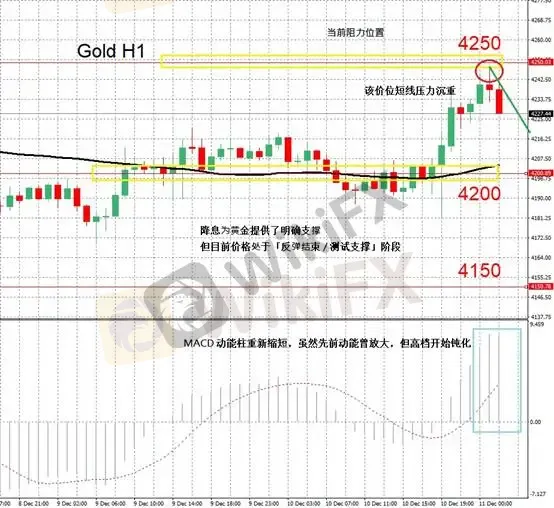
Price briefly spiked to 4,250 before being pushed back down, indicating heavy near-term resistance at that level.
The black moving average has flattened and slightly curved lower. Price is now pulling back toward the moving average, forming a “bullish breakout → pullback test” structure.
MACD histogram has begun to contract again. Momentum expanded earlier but is now showing signs of exhaustion at elevated levels.
Short-Term Outlook
The Feds dovish shift provides a clear tailwind for gold, leaving room for further strength. However, prices are currently in a “rebound exhaustion / support retest” phase, and a renewed bullish trend has not yet been confirmed.
Medium Term (1–2 Weeks)
If prices hold the 4,200–4,220 support zone—supported by both fundamentals and technicals—bulls may attempt another break of 4,250, with extension targets at 4,280–4,300.
A break below 4,200 would expose downside risk toward the 4,150 region.
Resistance: 4,250 USD/oz
Support: 4,200 / 4,150 USD/oz
Disclaimer:
The views in this article only represent the author's personal views, and do not constitute investment advice on this platform. This platform does not guarantee the accuracy, completeness and timeliness of the information in the article, and will not be liable for any loss caused by the use of or reliance on the information in the article.
WikiFX Broker
Latest News
The "VIP" Trap: Inside the Algo-Trading Nightmare at Zenstox
 WikiFX
A Simple Guide to WisunoFX Rules: Understanding Safety and Risks When Trading
WikiFXIs Deriv Safe? A Deep Dive into Regulatory Claims vs. Withdrawal Nightmares
WikiFXWisunoFX Review 2025: A Complete Look at Costs, Trading Platforms, and Safety
WikiFX9X Markets Review: Is It Reliable?
WikiFXIQ Option Review: Real User Experiences
WikiFXBessent to propose major overhaul of regulatory body created from financial crisis
WikiFXThe case for more Fed rate cuts could rest on a 'systematic overcount' of jobs numbers
WikiFXAdvanced Markets Exposed: Faulty Copy Trading & Execution Failures Cost Traders Dearly
WikiFXCoinlocally Broker Review: Coinlocally Regulation & Real User Complaints Exposed
WikiFXCurrency Calculator
USD

CNY
Current Rate: 0
Amount
USD
Available
CNY
Calculate