

Global Broker Regulation Inquiry App
About WikiFX
English
简体中文
繁體中文
English
Pусский
日本語
ภาษาไทย
Tiếng Việt
Bahasa Indonesia
Español
हिन्दी
Filippiiniläinen
Français
Deutsch
Português
Türkçe
한국어
العربية
اردو


Malaysia on Alert: The Gold Rush Is Becoming a Scam Boom

WikiFX
|


Abstract:As gold prices surge, a sharp rise in gold-related scams is draining retirement accounts and wiping out life savings.
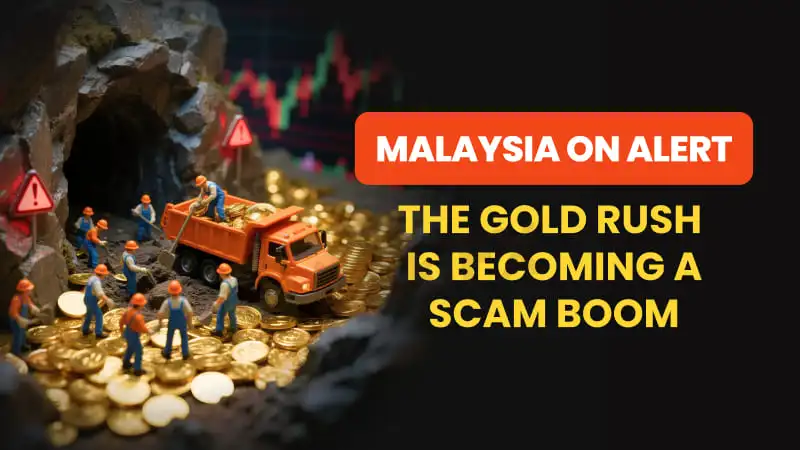
Gold is breaking records again. As global uncertainty deepens and inflation concerns linger, investors are pouring money into what they see as a safe haven. Bars, coins and digital gold products are selling at a rapid pace.
But as prices surge, so too does something far more troubling: a sharp rise in gold-related scams that are draining retirement accounts and wiping out life savings.
For Malaysian investors, where gold has long been part of wealth preservation culture, the warning signs could not be clearer. The very rally that promises security is now being exploited by organised fraud networks across the globe.
According to the World Gold Council, private investors collectively hold around 45,000 tonnes of gold in bars and coins — roughly 22 per cent of all gold ever mined. Demand for physical bullion alone represents about a quarter of annual global gold consumption, exceeding 1,000 tonnes each year.
The scale of participation shows how deeply investors trust the metal. Yet todays retail gold market is no longer limited to physical holdings. Investors can now buy tokenised gold on blockchain platforms, open digital gold savings accounts through apps, or trade gold-linked products online within minutes.
This convenience has lowered barriers to entry. It has also lowered barriers for criminals.
A global threat moving closer to home
The fraud wave is not isolated. It is accelerating.
In Texas, elderly victims lost more than US$55 million in gold-related scams. In the Boston area, authorities documented over 100 cases within two years where couriers physically collected cash or gold bars from victims, causing losses of more than US$26 million. Nearly all victims were above 60.
In Ottawa, criminals convinced an elderly couple to purchase US$460,000 worth of gold before arranging to collect it. The victims were instructed to keep the transaction secret from their bank and family — a tactic designed to prevent early detection.
Asia is seeing the same pattern. In Singapore, authorities reported at least 131 cases in 2025 involving victims who were persuaded to buy gold bars and hand them over. Although total scam losses in the country declined to US$913.1 million from a record US$1.1 billion in 2024, police highlighted a worrying shift. Criminal syndicates are increasingly demanding gold rather than bank transfers because gold is harder to trace and easier to move.
For Malaysian households, many of whom invest in gold jewellery, bullion or digital gold accounts, this development is deeply relevant. Fraud does not respect borders. Digital platforms make scams instantly accessible.
Technology is accelerating deception
Five schemes that are spreading quickly as gold prices rise:
The first involves aggressive upselling disguised as wealth planning. An investor may make a small, legitimate gold purchase at a fair market price. Shortly after, repeated phone calls begin. Sales representatives promote “exclusive” coins or collectible items at heavy mark-ups, marketing them as legacy assets for future generations. Many elderly buyers are unfamiliar with dealer spreads and secondary market pricing. Under sustained pressure, they commit far more money than they initially intended.
The second scheme exploits social media. Fraudsters copy the branding of established jewellery stores or bullion dealers and advertise gold at attractive prices. They claim the physical outlet is temporarily closed and request deposits to secure purchases. When buyers attempt to collect their items, the address proves fictitious.
The third red flag lies in payment methods. Sellers who refuse traceable systems such as credit cards or regulated bank transfers should trigger immediate concern. Wire transfers are difficult to reverse. Legitimate dealers typically operate within regulated banking frameworks and welcome transparency.
Fourth are fraudulent digital investment platforms offering gold-backed tokens or online gold accounts. Investors may see their balances rising on screen, creating a false sense of profit. When they attempt to withdraw funds, they are told to pay unexpected taxes or administrative charges. In reality, the funds have already been diverted. Additional payments only compound the loss.
The fifth scheme is particularly cruel: recovery scams. After victims lose money, their contact details are sold to other fraudsters. Someone posing as a lawyer, regulator or government official offers to recover the funds in exchange for an upfront fee. The victim, already distressed, risks losing even more.
Industry response and its limits
Gold itself remains a legitimate asset. The problem lies in unregulated marketing, opaque pricing and cross-border digital platforms that operate beyond easy oversight.
To improve trust, the World Gold Council introduced its Retail Gold Investment Principles following consultations with 52 stakeholders across 16 countries. The voluntary framework promotes transparent pricing, proper safeguarding of client assets and regulatory compliance.
However, voluntary guidelines cannot eliminate criminal activity. Investors must remain vigilant.
In the United States, the Federal Trade Commission has warned of criminals impersonating government officials who claim that victims bank accounts or identification numbers are linked to criminal activity. Victims are instructed to convert savings into gold for “protection” and hand the bars to couriers. Law enforcement agencies stress that no legitimate authority will ever request such action.
These tactics are increasingly reported worldwide.
The warning for Malaysian investors
The urgency is real. High gold prices create emotional pressure. Investors fear missing out on further gains. Scammers exploit that urgency with tight deadlines, “limited allocations” and promises of guaranteed returns.
Malaysians should treat unsolicited calls, messaging app promotions and social media advertisements offering gold investments with extreme caution. Investors should verify real-time gold prices on independent platforms, confirm dealer registrations with relevant regulators such as Bank Negara Malaysia or the Securities Commission Malaysia, insist on traceable payment methods and consult trusted family members or licensed financial advisers before making substantial purchases.
No legitimate investment requires secrecy. No credible dealer guarantees profits. And no government agency demands that citizens buy gold bars and hand them over.
Gold may remain a hedge against economic turbulence. But in todays environment, the greater risk may not be market volatility but deception.
As prices climb, the message for Malaysian investors is simple and urgent: do not let the promise of safety become the gateway to loss.
Disclaimer:
The views in this article only represent the author's personal views, and do not constitute investment advice on this platform. This platform does not guarantee the accuracy, completeness and timeliness of the information in the article, and will not be liable for any loss caused by the use of or reliance on the information in the article.
WikiFX Broker
Latest News
Dow Jones Industrial Average round-trips a Fed that promised nothing
WikiFXSouth Korean Won: BoK tightening supports KRW against US Dollar – Commerzbank
WikiFXUSDCHF: Rising Channel Continuation Toward the Target Zone
WikiFXMexican Peso tumbles as Warsh embarks on inflation fight
WikiFXBreaking: Nonfarm Payrolls benchmark revision to lower US employment by 79,000 through March 2026
WikiFXJapanese Yen dips further despite hotter inflation, upbeat employment data
WikiFXPoland: Growth supported by investment rebound – ING
WikiFXSilver Price Forecast: False breakout and hawkish Fed sink XAG
WikiFXOEXN Broker Review: Regulated but is it Safe for Traders?
WikiFXGBPUSD | Bearish Breakdown & Downside Continuation
WikiFX