Abstract:On July 23–24, renowned economist Fu Peng, a specially appointed financial think-tank expert for national media outlets such as Xinhua News Agency and China Central Television, will be in Hong Kong to attend the WikiEXPO. He will join global industry leaders, regulatory representatives, and fintech experts to discuss new challenges to trading safety amid macroeconomic shifts.
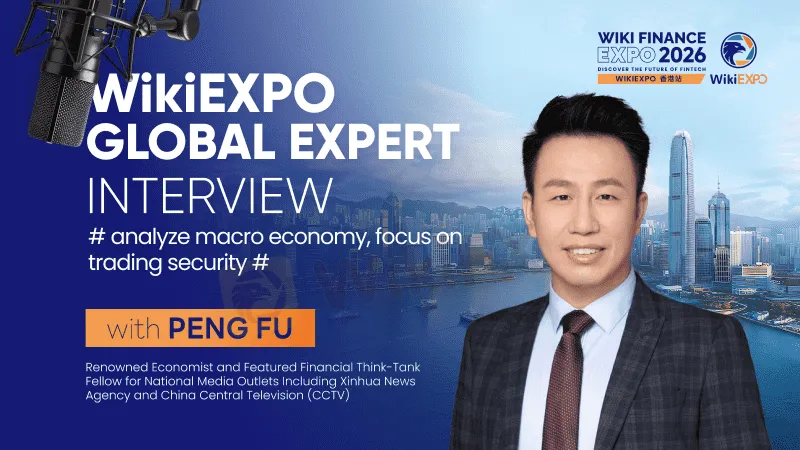
On July 23–24, renowned economist Fu Peng, a specially appointed financial think-tank expert for national media outlets such as Xinhua News Agency and China Central Television, will be in Hong Kong to attend the WikiEXPO. He will join global industry leaders, regulatory representatives, and fintech experts to discuss new challenges to trading safety amid macroeconomic shifts.
Against the backdrop of an accelerating restructuring of global financial markets, the trading environment is facing unprecedented uncertainty. Centered on this core theme, WikiEXPO conducted an exclusive interview with Mr. Fu Peng. This interview will be released as a series, with each installment focusing on a key issue and presenting Mr. Fu Pengs in-depth insights into the evolving global landscape of trading security.
Following the first installment, which focused on changes in the macro landscape, this second part of the series addresses a critical question:
As global debt and asset prices rise simultaneously, is trading risk being repriced?
Is risk accumulating amid persistently high global debt levels?
In this installment, Fu Peng shares his views on the current historical highs in global debt and asset prices, offering his assessment of the underlying structure of market risks.
Fu Peng believes that this risk is indeed gradually emerging.
First, looking back over more than a decade since the 2008 global financial crisis, major economies around the world have essentially followed a similar policy path: By shifting large-scale debt to the government sector and maintaining a prolonged low-interest-rate environment alongside extremely loose monetary policies, they aimed to stabilize market risks and buy time for economic restructuring.
This policy mix has provided strong “support” for financial assets over the past decades.
However, with ongoing technological advancements, the global productivity structure is now undergoing significant changes, and a new set of production relationships for economic development is being reshaped. In this context, the previous model—relying on loose policies to sustain asset prices—may gradually shift.
In addition, Fu Peng points out that debt itself is not necessarily the problem. What truly matters is how the debt is sustained and how policies evolve. If this support system begins to turn more conservative, certain financial assets could face notable trading risks.
In other words, someone in the market will ultimately have to “pay” for these risks.
That said, unlike in the past, current technological progress and improvements in productivity may help buffer the widespread transmission of risk. Therefore, such risks may not necessarily evolve into a systemic financial crisis.
However, for assets that have been heavily supported by liquidity and have seen continuously rising valuations over the past decades, Fu Peng believes:
“There may be a final liquidity-driven rally.”
July in Hong Kong: Discussing the Future of Trading Safety
As a globally recognized fintech and trading industry event, WikiEXPO has always been committed to gathering industry insights, fostering open dialogue, and driving the fintech ecosystem's continuous evolution.
At the upcoming WikiEXPO Hong Kong, Fu Peng will share more in-depth perspectives. We look forward to meeting industry participants from around the world offline to explore a more robust, efficient, and transparent fintech future together.
📍 July 23–24, Hong Kong
Engage in a live dialogue with Fu Peng and seek certainty in an uncertain era.
WikiEXPO Hong Kong — we look forward to seeing you there.