Abstract:On July 23–24, renowned economist Fu Peng will attend WikiEXPO Hong Kong in Hong Kong, joining global industry leaders, regulatory representatives, and fintech experts to discuss the evolving challenges of trading safety amid macroeconomic transformation.
Against the backdrop of accelerating restructuring in global financial markets, the trading environment is facing unprecedented uncertainty. To explore this critical theme, WikiEXPO conducted an exclusive interview with Mr. Fu Peng. This interview series will be released in multiple episodes, each focusing on a key question and presenting his in-depth insights into the global trading risk landscape.
Following the first episode, which examined macro structural shifts, this third episode turns to one of the most pressing topics for investors today:About asset allocation in an uncertain world, how should investors interpret the concept of “hard currency”? And which asset classes offer greater transparency and more controllable risks?
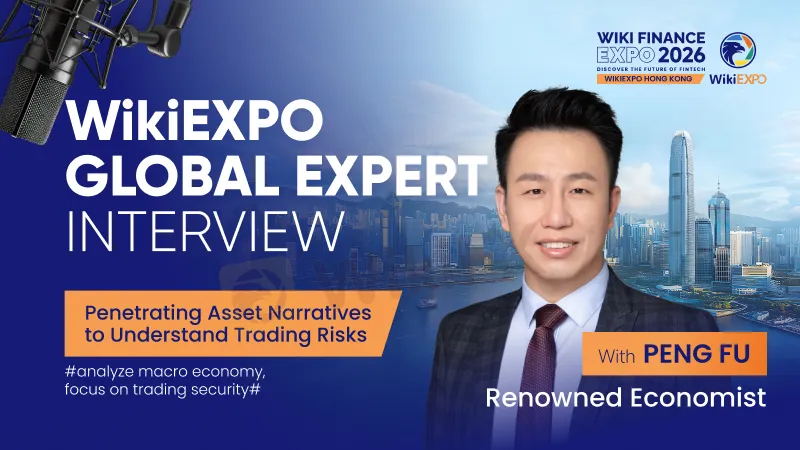
On July 23–24, renowned economist Fu Peng will attend WikiEXPO Hong Kong in Hong Kong, joining global industry leaders, regulatory representatives, and fintech experts to discuss the evolving challenges of trading safety amid macroeconomic transformation.
Against the backdrop of accelerating restructuring in global financial markets, the trading environment is facing unprecedented uncertainty. To explore this critical theme, WikiEXPO conducted an exclusive interview with Mr. Fu Peng. This interview series will be released in multiple episodes, each focusing on a key question and presenting his in-depth insights into the global trading risk landscape.
Following the first episode, which examined macro structural shifts, this third episode turns to one of the most pressing topics for investors today:About asset allocation in an uncertain world,How should investors interpret the concept of “hard currency”? And which asset classes offer greater transparency and more controllable risks?
There Is No “Natural Hard Currency” — Asset Value Is Cyclical
When asked which asset—gold, Bitcoin, commodities, or forex—is most likely to become a “hard currency” in the coming years, Fu Peng offered a clear perspective:
No asset class can inherently serve as a long-term “hard currency.”
In his view, all assets are essentially vehicles whose prices fluctuate around underlying macroeconomic logic. Their performance is determined by economic cycles and institutional environments, rather than by labels.
Take gold as an example. During periods of global order reshaping or systemic transformation, governments often absorb and redistribute large-scale debt, reinforcing golds safe-haven appeal and pushing prices higher. However, when productivity and economic structures stabilize, gold may also experience prolonged periods of stagnation.
This highlights a key principle:
The essence of investing is not identifying a “safe” asset, but understanding its underlying drivers and cyclical position.
Transparency and Risk: Traditional Assets Are More Mature, Not Risk-Free
When comparing investment environments, Fu Peng noted that from a product perspective, traditional financial markets hold structural advantages.
Markets represented by FICC (fixed income, currencies, and commodities) benefit from long development histories and well-established regulatory frameworks:
- More mature disclosure mechanisms
- More stable pricing systems
- Clearer risk identification pathways
As a result, these assets generally offer higher transparency and relatively more controllable risks.
However, he emphasized that “controllable” does not mean “risk-free.” Once complex derivatives or excessive leverage are introduced, risks can escalate rapidly—regardless of the asset class.
Crypto Assets: From Opaque Risk to Gradual Normalization
Regarding crypto assets, Fu Peng pointed out a structural transition in progress.
In their early stages, crypto markets were characterized by:
- Lack of regulation
- Low transparency
- Highly concentrated risks
Today, as mainstream markets gradually bring crypto assets under regulatory oversight—and as institutional capital begins to participate—the landscape is evolving:
- Transparency is improving
- Risks are increasingly being priced
- The overall environment is becoming more structured
Hong Kong, July: Shaping the Future of Trading Safety
As a leading global fintech and trading industry event, WikiEXPO is committed to bringing together industry insights, fostering open dialogue, and driving the continuous evolution of the financial ecosystem.
At the upcoming WikiEXPO Hong Kong, Fu Peng will share further in-depth perspectives. We look forward to connecting with global participants in person to explore a more resilient, efficient, and transparent future for fintech.
July 23–24 · Hong Kong
Engage with Fu Peng live.
In an age of uncertainty, seek answers grounded in clarity.
WikiEXPO Hong Kong — we look forward to welcoming you.
Download the new WikiFX app for updated broker rankings and regulatory statuses by scanning this QR code.