Abstract:Forex traders often wonder why the same currency pair, for instance, EUR/USD, shows 1.17450 on one broker but 1.17455 on another. This difference creates suspicion among traders, often leading to wrong calls and losses. Calm your nerves first by understanding that small price variations are normal and are a reflection of the global forex market’s operation.
The forex market is decentralized with no single exchange or official price for any currency pair. That is some revelation for new forex traders. So, what’s the methodology for price determination? It is derived from an expanded network of financial institutions, banks, liquidity providers and brokers globally. So, as a forex trader, you must understand the price structure thoroughly to stay out of unnecessary chaos and continue to reap rewards.
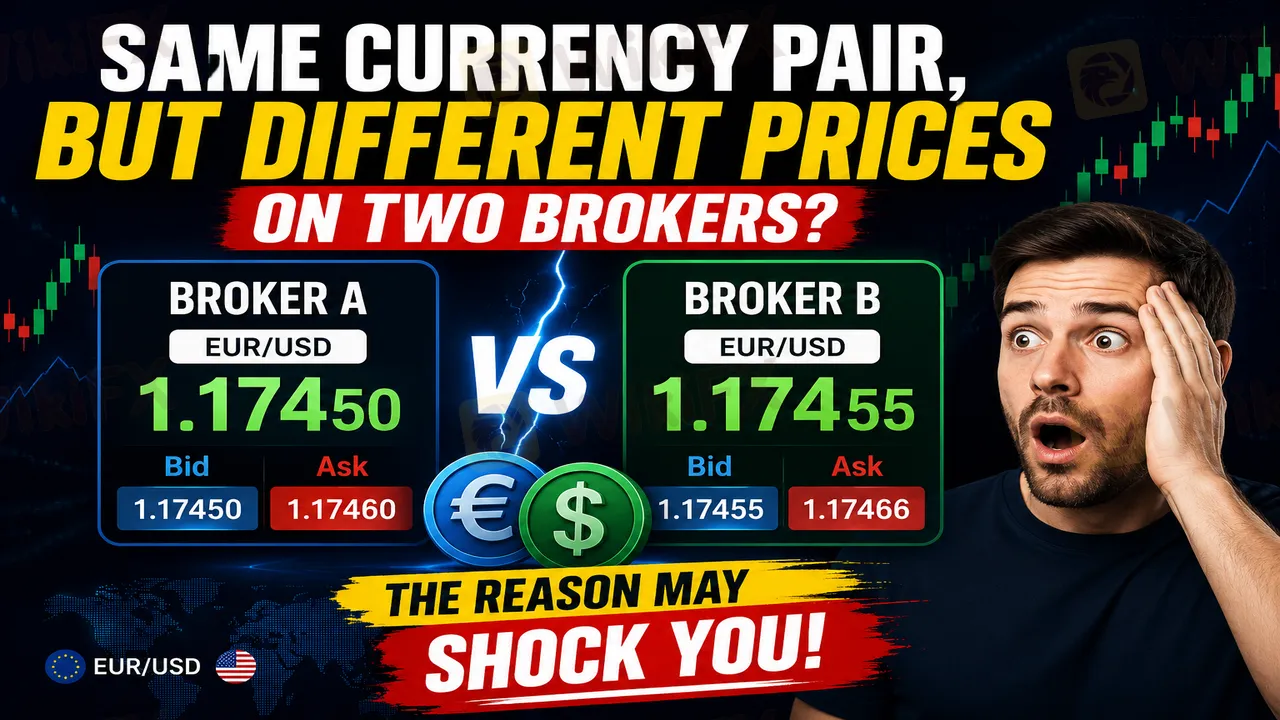
Forex traders often wonder why the same currency pair, for instance, EUR/USD, shows 1.17450 on one broker but 1.17455 on another. This difference creates suspicion among traders, often leading to wrong calls and losses. Calm your nerves first by understanding that small price variations are normal and are a reflection of the global forex markets operation.
The forex market is decentralized with no single exchange or official price for any currency pair. That is some revelation for new forex traders. So, whats the methodology for price determination? It is derived from an expanded network of financial institutions, banks, liquidity providers and brokers globally. So, as a forex trader, you must understand the price structure thoroughly to stay out of unnecessary chaos and continue to reap rewards.
 Contents
How Does the Decentralized Forex Market Operate?
While trading stocks, every participant on a particular exchange usually witnesses the same price. The reason: its a centralized marketplace. But forex does not work like this. It operates over the counter (OTC), demonstrating direct transactions between banks, brokers and institutions as opposed to through a single exchange.
Brokers receive price quotes from one or multiple liquidity providers, including banks, non-banking financial companies, and electronic communication networks (ECNs).
As brokers may vary in terms of their liquidity providers, the chances of bid and ask prices received by them can change slightly at any point.
Therefore, a price difference accounting for a fraction of a pip or a few pips amid a volatile scenario can always happen, and traders must be prepared for this.
When There are Different Liquidity Providers, There Can Always be Different Prices
The liquidity source of a broker primarily dictates the pricing structure it will have for currency pairs on its platform. Depending on the reach, brokers can vary with each other based on their liquidity provider count. While one broker may find price quotes from several providers, the other may get them from very few institutions, making a price difference imminent. It is observed that several brokers aggregate currency pair prices from multiple liquidity providers before displaying the best available bid and ask quotes. At the same time, some brokers may add their own markup before displaying prices on the platform.
Spread and Broker Pricing Models
A lot also depends on the pricing model adopted by the broker. Market makers usually quote their own bid and ask prices and may add a wider spread to them to get compensated for their services. Conversely, STP and ECN brokers usually pass through prices received from liquidity providers while charging a smaller spread or a commission. Demonstrating further versatility in the forex space, some brokers who advertise raw spreads can have EUR/USD spreads dip to zero during liquid market hours, while others, unperturbed by the market movement, continue to charge fixed or wider spreads. So, while the underlying market price may seem identical, the buy and sell prices on the platform can vary due to brokers' spread policy.
Market Volatility Only Amplifies Differences
During economic announcements such as inflation data, non-farm payrolls (NFP) or central bank interest rate decisions, users can always be subject to price discrepancies. There are high possibilities of liquidity disappearance during these events as banks widen their quotes to manage risks. As brokers receive updated prices at slightly different speeds from different liquidity providers, traders can witness temporary price differences larger than usual.
During these times, spreads usually widen, execution speeds change, and slippage appears to bite traders profits. Experienced traders, therefore, exercise caution when trading instantly based on news releases during news events.
Server Location & Technology
In a fast-paced forex market landscape, it could be the difference of just a few milliseconds that can make or break your situation. Therefore, a broker with trading services in proximity to major financial data centers may receive and disseminate updated prices faster than a broker operating from a region far away from the liquidity providers. Despite these delays being extremely small, they can cause temporary quote differences, especially when the market moves very quickly. Retail traders may not be affected by these differences. However, those relying on scalp or high-frequency trading may fail to execute their trades properly.
When Should Price Differences Demand Caution?
- Extremely large price deviations compared to several reputable brokers.
- Frequent abnormal price spikes affecting only one broker.
- Stop-loss or take-profit orders triggering while comparable market prices never reached those levels elsewhere.
- Repeated complaints from users regarding execution quality or unexplained pricing anomalies.
In such situations, comparing live prices across multiple brokers and reviewing the broker's regulatory status and execution policies can provide valuable insights.
The Bottom Line
Two brokers displaying slightly different prices for the same currency pair is usually a natural consequence of the decentralized forex market rather than evidence of price manipulation. Differences in liquidity providers, spread policies, pricing models, server infrastructure, and market volatility all contribute to small variations in quoted prices.
Instead of focusing solely on finding identical quotes across brokers, traders should evaluate the overall quality of execution, transparency, regulatory oversight, and consistency of pricing. A reliable broker is not necessarily the one displaying the lowest price—it is the one that delivers fair execution, dependable order processing, and transparent trading conditions over the long term.
Download the WikiFX app for more such in-depth forex insights.

Interesting Articles for You
Review 2026: The Broker Deleted My Profits Citing Rule Violation. But Where is the Proof?