Abstract:A broker can launch a white-label platform quickly and still fail the first serious operating test. The failure often begins quietly: an assets expansion has been approved, the client app is branded, and a new account journey looks complete. Then a client asks why a trade-related status, funding hand-off, or account restriction looks different across channels. Support cannot see the same reference trail as operations. The product owns the screen, but no one owns the explanation. The issue is not a missing feature. It is an untested operating model.
That is why a cTrader white label platform should be evaluated as a route to a multi-asset service - not as a shortcut to a more attractive terminal. The central question is whether the broker can add instruments, client channels, integrations, and service capacity without making its controls harder to operate or explain.
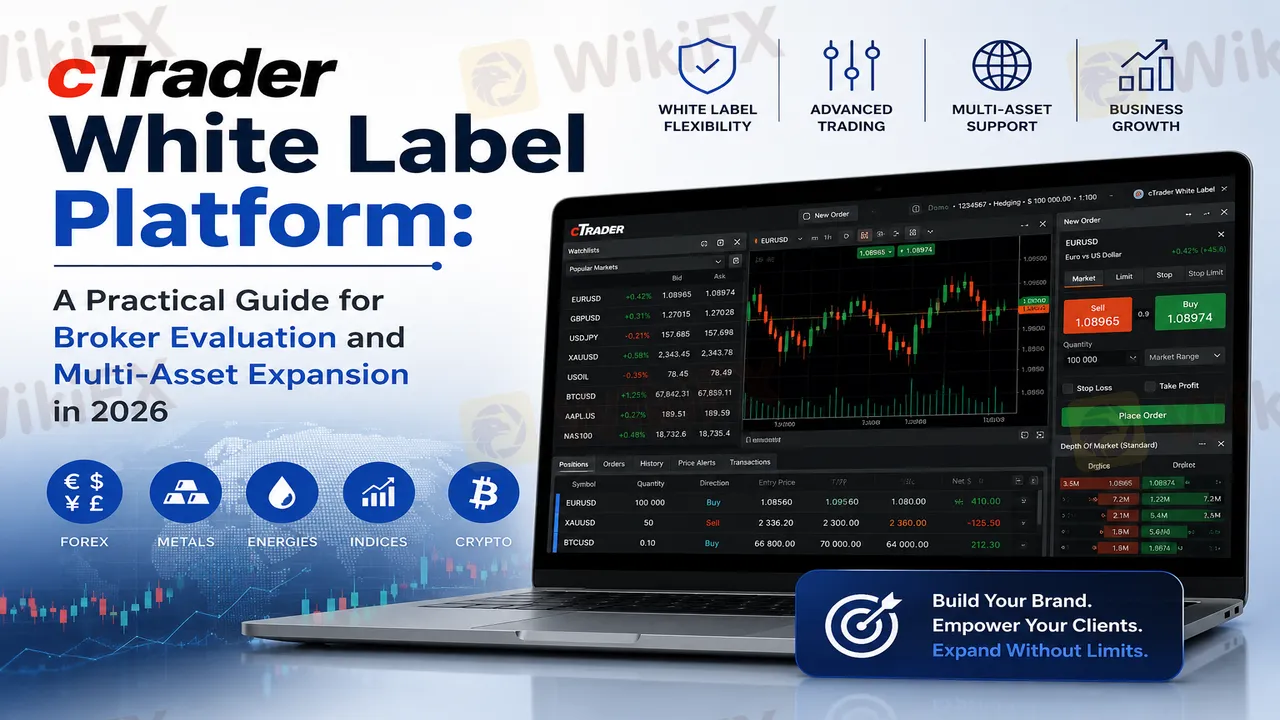
**Editorial and risk note:** This is a B2B evaluation guide for brokerage executives, operations leaders, and technology teams. It is not investment advice, a provider recommendation, or a promise of execution quality, regulatory approval, client growth, or trading results. Confirm current product scope, commercial terms, jurisdictional requirements, and control responsibilities with the relevant provider and advisers.
A broker can launch a white-label platform quickly and still fail the first serious operating test. The failure often begins quietly: an assets expansion has been approved, the client app is branded, and a new account journey looks complete. Then a client asks why a trade-related status, funding hand-off, or account restriction looks different across channels. Support cannot see the same reference trail as operations. The product owns the screen, but no one owns the explanation. The issue is not a missing feature. It is an untested operating model.
That is why a cTrader white label platform should be evaluated as a route to a multi-asset service - not as a shortcut to a more attractive terminal. The central question is whether the broker can add instruments, client channels, integrations, and service capacity without making its controls harder to operate or explain.
 Contents
Executive Takeaways
· A multi-asset strategy is only credible when the client journey, data trail, support ownership, and exception process expand with it.
· Test providers through operational scenarios, not only a polished feature demo.
· Spotware's published white-label material describes desktop, web, iOS, and Android access plus configurable components; validate the exact scope, controls, and commercial terms for your agreement.
· White-label adoption is being shaped by demands for speed, channel coverage, integrations, and third-party resilience. None of these remove the broker's accountability.
· Use a staged procurement-to-pilot process with explicit rollback and go/no-go criteria.
1. The Implementation Failures That are Easy to Miss

Editorial image: brokerage leaders evaluating a controlled multi-asset expansion plan.
Some failures are obvious: a planned integration does not work, a launch date moves, or a commercial cost is not approved. The more damaging failures look like ordinary service friction until volume rises. A client may receive a status in a mobile channel that the support agent cannot interpret. A new instrument group may require an additional risk or reporting step that was never documented. A payment exception may be treated as a platform fault because the boundary between systems is unclear.
These are governance and design problems. Adding assets increases the number of product rules, event types, reference points, and teams that must give a consistent answer. A broker that has not mapped those dependencies can deliver a technically available platform but an unreliable client service.
Composite Implementation Scenario 1: The Fast Expansion That Created Manual Work
The following is illustrative, not a claim about any named broker. A regional broker uses a white-label platform to extend its proposition beyond its existing core instruments. Commercial teams set an aggressive launch date. The platform team completes configuration, but the case taxonomy in CRM still uses the old product structure. When clients ask about a new instrument category, agents create free-text tickets and operations reconstruct events manually.
The practical lesson is not “slow down every launch.” It is to make service design an acceptance condition. Before a new asset group is enabled, the broker should prove that identifiers, status definitions, support tags, reporting hand-offs, and escalation owners are aligned.
**Common implementation mistake:** Treating the multi-asset catalogue as a product-config change only. The correct scope also includes client disclosures, support logic, risk controls, reporting, monitoring, and change ownership.
2. Why White-label Adoption is Being Driven by Operating Needs
White label is not a single industry trend with one cause. Different brokers have different motivations. Some want a faster route to a branded service. Some want to serve a new B2B segment. Others need broader channel coverage or a more coherent technology ecosystem. The common thread is the desire to assemble a market proposition without building every component from scratch.
Current provider material from Spotware describes cTrader white labels as customisable broker solutions with desktop, web, iOS, and Android interfaces. It also presents white-label distribution as a way for an established broker to provide a branded service to partners. These are useful starting points for an evaluation, not proof that any particular broker will launch faster or more safely.
Three operating trends deserve attention:
Channel Consistency is Now a Control Issue
When clients move between web and mobile, inconsistent labels, permissions, or notifications create more than a design inconvenience. They create extra contacts, ambiguous case ownership, and communication risk. A cTrader broker solution evaluation should therefore test the same account and order-related scenario across the actual channels that will be launched.
Integration Breadth Creates Both Choice and Dependency
Multi-asset expansion rarely sits inside the terminal alone. It touches CRM, client portal, KYC/AML, payments, risk, market data, reporting, communications, and analytics. More connections can support a better service, but every connection creates a dependency that needs a source of truth, monitoring, incident route, and change process.
Third-party Resilience is Moving into the Board Conversation
The FCA's up-to-date guidance makes the principle clear in a regulated context: firms remain responsible for managing risk from outsourced and third-party arrangements, and should map the people, processes, technology, facilities, information, and dependencies that deliver important services. The exact rulebook may differ by jurisdiction, but the operating lesson is broadly useful. A provider relationship is not a transfer of accountability.
3. Define the Multi-asset Operating Model Before Scoring Platforms
The phrase “multi-asset” can be too vague to procure against. Specify what will change in the client proposition and in the broker's internal work. Is the intent to add instrument groups, introduce a new client segment, support partner distribution, add a channel, or replace fragmented journeys? Each goal produces a different evaluation brief.
Use a one-page operating-model statement before requesting demonstrations. It should define:
· target client and partner segments;
· initial instrument and channel scope;
· permitted jurisdictions and compliance boundaries;
· client onboarding and ongoing-service owners;
· authoritative data sources and event identifiers;
· dealing, risk, reporting, and reconciliation responsibilities;
· incident communication and change approval routes;
· commercial assumptions and the conditions for scale.
This turns platform selection into a testable decision. It also prevents a provider from having to guess which capabilities matter most to your broker.
Evaluation Matrix: What Must Scale with the Asset Set
4. A Workflow for Procurement and Controlled Launch

Workflow visual: the five gates from provider evaluation to a controlled scale decision.
The visual workflow below is a decision model, not a promise of a fixed project duration. Some brokers will need more time for legal, technical, or operational validation. The discipline is to move forward only when each decision gate has evidence.
Workflow: evaluate -> design -> test -> pilot -> scale
1. Evaluate. Define target segments, multi-asset scope, non-negotiable controls, and procurement owners.
2. Design. Map client journeys, operating roles, integrations, data ownership, and support scripts.
3. Test. Run provider demonstrations against normal and exception scenarios; validate access, exports, reconciliation, incident, and change procedures.
4. Pilot. Limit the initial scope and sample real operational cases. Track evidence quality, routing time, defects, and repeat contacts.
5. Scale. Expand only when known issues have an owner, a dated remediation plan, and a clear decision on residual risk.
This approach breaks a long technical programme into shorter accountable decisions. It also makes executive involvement useful: leadership can decide whether the evidence supports the next gate, instead of trying to resolve every implementation detail.
**Common implementation mistake:** Using the signature date as the programme's main success metric. A better metric is whether the broker can operate the agreed client service, including a documented fallback when a dependency fails.
5. How to Evaluate a cTrader White Label Platform in Practice
The strongest vendor meeting is not a generic overview. It is a set of scripted tests built from your operating-model statement. Ask each provider to distinguish between what the platform supports, what the broker configures, what an integrated vendor owns, and what remains the broker's responsibility.
Test Client and Operations Journeys Together
Choose at least two journeys. The first should be ordinary: onboarding, access, account navigation, and a standard product interaction. The second should be an exception: a status question, account restriction, failed hand-off, or activity that must be escalated. For each, record the client-facing wording, system-of-record, IDs, user roles, response owner, expected time boundary, and approved communication route.
The aim is not to simulate every possible incident. It is to prove that the broker can trace and explain the journeys most likely to cross functions.
Test Administrative and Data-Control Boundaries
Questions about cTrader white label cost should never be separated from control questions. A low headline cost can be outweighed by repeated manual reconciliation, poor visibility for support, or expensive changes. Ask what roles can view or export relevant data, how permissions are administered, which information remains available after an event, and what data portability or exit provisions apply.
Document the answers in a register. Do not rely on verbal assurances, screenshots, or demo-only access. Commercial, legal, security, and operational teams should see the same versioned record.
Test the Partner-Distribution Model Separately
If the broker plans to offer white-label capacity to partners, there is an additional layer of control. Branding, client ownership, service levels, reporting, complaint handling, and escalation between the broker and partner must be defined. Spotware's provider material discusses white-label distribution and customised interfaces; it does not remove the need to document who can make which change or who speaks to the end client when something goes wrong.
6. Composite Case Study 2: A Pilot That Made Scale Safer
This second scenario is also composite and illustrative. A broker wants to add a new multi-asset proposition but does not enable it for the full client base. It selects a limited cohort, freezes the initial product list, and requires every client case to carry a usable reference ID. Support, operations, compliance, and product review a sample of cases weekly. One integration produces delayed status updates; instead of treating the delay as an isolated defect, the team adds an explicit client-message owner and a reconciliation exception queue.
The pilot does not prove that future scales will be friction-free. It does create a more credible basis for the decision: measured defects, named owners, tested workarounds, and a clear list of controls that must be in place before expansion.
What to Measure in a Controlled Pilot
· percentage of sampled cases with a complete evidence trail;
· median time to route and close a defined case type;
· repeat-contact rate for the same unresolved issue;
· number and age of reconciliation exceptions;
· change requests raised after client or staff feedback;
· unresolved dependencies and the owner of each remediation.
Avoid presenting pilot results as proof of better client trading outcomes. They are operational readiness evidence.
7. Commercial and Technical Diligence: Keep the Questions Linked
An evaluation of a cTrader platform provider should bring commercial and technical diligence together. Request a written fee schedule that names the service entity, currency, billing cadence, environment assumptions, included channels, account or usage metrics, optional modules, change process, support scope, taxes, termination mechanics, data export, and exit obligations. Model base, growth, and stress cases rather than relying on a single volume forecast.
Then connect every commercial line to an operating impact. For example, if a pricing unit changes as active accounts grow, identify who monitors it and whether the forecast matches product scope. If an integration or environment has a separate charge, identify its owner, testing cost, and fallback. If changes require vendor delivery, identify the approval route and realistic lead time. This is where an apparent price comparison becomes a decision about total operating cost and control.
8. Executive Checklist Before a Scale Decision
· Is the multi-asset proposition defined in client, operational, and commercial terms?
· Have normal and exception journeys been tested on every launch channel?
· Is there an authoritative reference trail from client query to internal response?
· Are platform, broker, and integrated-service responsibilities documented?
· Are access, export, reconciliation, incident, change, and exit controls evidenced?
· Does the business case include implementation, support, integration, assurance, change, and exit costs?
· Are partner roles and end-client responsibilities explicit where distribution is planned?
· Has the pilot produced a decision log with unresolved risks and named owners?
· Can the broker pause or roll back a limited scope without confusing clients or losing control of records?
Frequently Asked Questions (FAQs)
What is a cTrader white label platform?
It is a broker-facing arrangement built around cTrader technology and associated services, normally configured for a broker's own client proposition or partner distribution. The exact channel, administrative, integration, commercial, and support scope depends on the agreement and should be confirmed directly with the provider.
Does a cTrader white label automatically support multi-asset expansion?
No. A platform can support elements of a broader proposition, but expansion still requires a broker-defined product scope, controls, integrations, client communications, and operating readiness. Validate the specific capability and responsibility split for your intended model.
What is the most important question for a cTrader broker solution evaluation?
Ask whether the broker can consistently operate and explain the client service that it intends to launch. That includes ordinary journeys, exception handling, data access, integrations, commercial triggers, and third-party dependencies.
How should a broker compare cTrader white label cost?
Compare written commercial terms together with internal implementation, integration, support, assurance, change, and exit costs. Use volume and stress scenarios; do not rely on generic online price claims.
Conclusion: Use the cTrader White Label Platform to Scale an Operating Model
A cTrader white label platform can be a practical component of a multi-asset expansion, but only when the broker treats it as an operating-model decision. The better evaluation starts with the implementation failures clients are most likely to experience, proves the evidence path across channels and integrations, and uses a controlled pilot before scale. That produces a more disciplined decision than a feature checklist - and a service that is easier to govern after launch.
Sources and Further Reading
· Spotware: cTrader White Labels - provider material on white-label distribution, client interfaces, and configurable scope; verify current terms directly with the provider.
· Financial Conduct Authority: Outsourcing and operational resilience - current guidance on managing third-party and outsourcing risks.
Contact us on WhatsApp for more specific trading details. Here's our number - +852 6317 7384 with this name - Wikifx-link.
Download the WikiFX App for the latest forex updates.

Knowledge pays at WikiFX.
Every time you share a WikiFX article, you'll receive 50 Reward Points. Grow your rewards with every share and unlock exclusive gifts in the WikiFX Points Mall. Start earning today!
Here's a Step-by-Step Process.