

Global Broker Regulation Inquiry App
About WikiFX
English
简体中文
繁體中文
English
Pусский
日本語
ภาษาไทย
Tiếng Việt
Bahasa Indonesia
Español
हिन्दी
Filippiiniläinen
Français
Deutsch
Português
Türkçe
한국어
العربية
اردو


Cent Accounts: Redefining the First Step Into Live Trading


Abstract:As global financial markets continue to evolve, retail participation in Forex, Gold, and Contracts for Difference (CFDs) has expanded significantly. The rapid growth of online trading platforms, wider
As global financial markets continue to evolve, retail participation in Forex, Gold, and Contracts for Difference (CFDs) has expanded significantly. The rapid growth of online trading platforms, wider access to financial education, and the increasing adoption of automated trading technologies have made live market participation more accessible than ever before. At the same time, the industry is placing greater emphasis on providing trading solutions that better support traders at different stages of their journey.
For many beginners, learning how to trade is no longer the biggest challenge. The real challenge lies in taking the first step into live markets.
For years, demo accounts have played an important role in trader education. They allow users to understand trading platforms, practise strategies, and gain familiarity with market mechanics without risking real capital. However, because demo trading does not involve financial consequences, it cannot fully replicate the psychological discipline, position management, and risk awareness required in live trading. As a result, the transition from a demo account to a live account remains one of the most challenging stages for many new traders.
As the retail trading industry continues to mature, a new question is emerging: Does entering the live market necessarily require significant capital from day one?
This changing perspective has encouraged brokers to rethink how entry-level trading accounts are designed.
Rather than simply lowering the minimum deposit, many brokers are focusing on creating account structures that allow traders to experience real market conditions while managing risk more effectively. Within this broader industry trend, Cent Accounts have become an increasingly important solution.
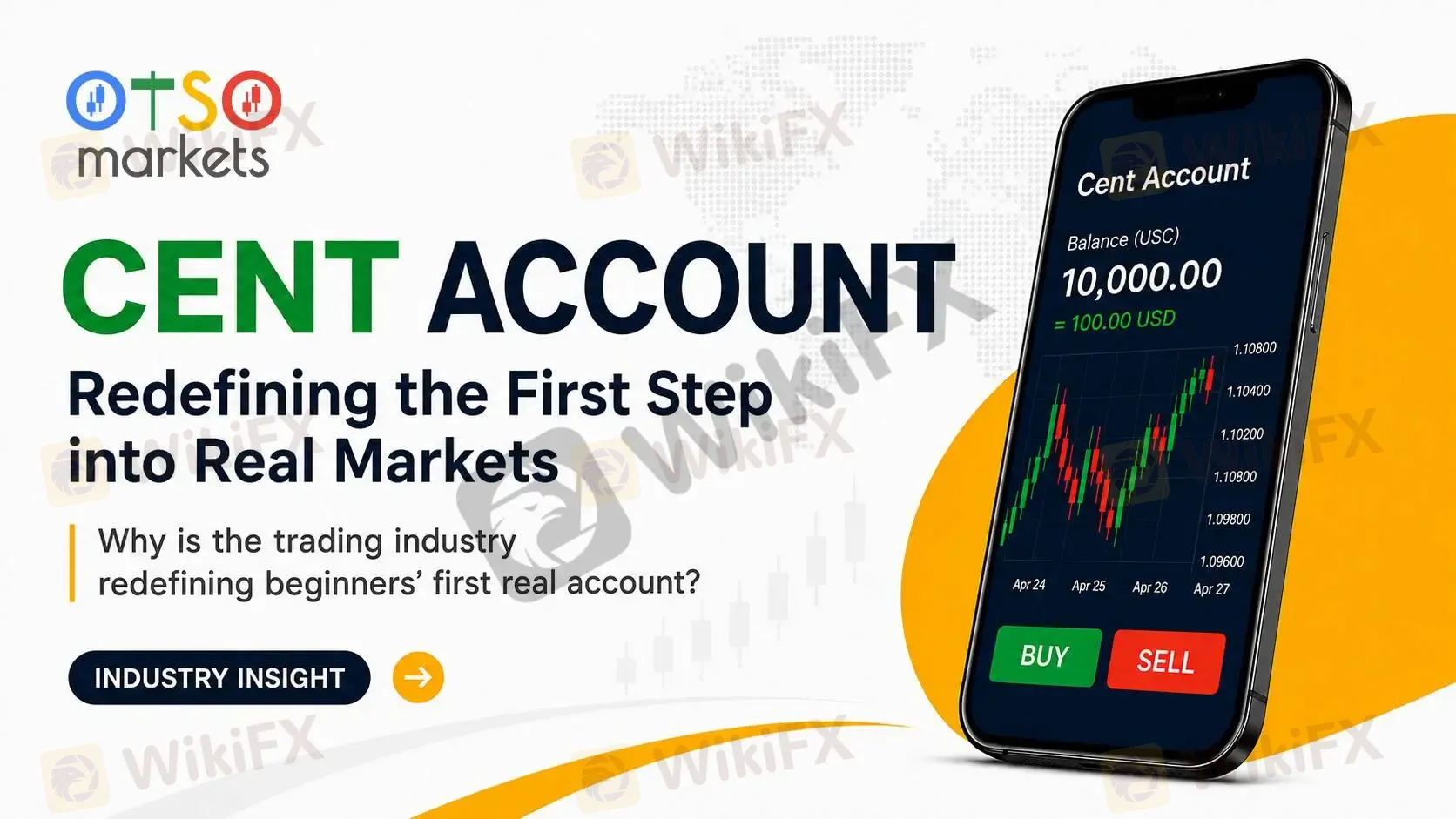
Unlike traditional standard accounts, a Cent Account uses USC (US Cents) as its account currency, where 1 USD equals 100 USC. For example, a deposit of USD 100 is displayed as 10,000 USC. While the account's actual monetary value remains unchanged, the smaller denomination enables traders to trade with finer position sizing, making it easier to develop sound money management and risk management habits under real market conditions.
The growing importance of Cent Accounts extends beyond accessibility.
As more traders adopt Expert Advisors (EA), systematic trading strategies, and quantitative models, validating trading performance in live market conditions has become increasingly valuable. Compared with simulated environments, live markets provide genuine pricing, liquidity, order execution, and market volatility, allowing traders to evaluate their strategies before gradually increasing their trading capital.
This reflects a broader shift across the retail trading industry. Rather than focusing solely on tighter spreads or higher leverage, brokers are increasingly investing in products that promote responsible trading, stronger risk management, and sustainable trader development.
Recognising this industry trend, OTSO Markets has introduced its Cent Account, designed for beginners, strategy developers, and traders seeking real market experience with controlled capital exposure. Available on MetaTrader 5 (MT5), the account uses USC as its account currency, requires a minimum initial deposit of USD 100 (10,000 USC), supports a minimum trade size of 0.01 cent lot, offers leverage of up to 1:1000 (subject to dynamic leverage conditions), features floating spreads with zero commission, and supports Expert Advisors (EA).
The OTSO Markets Cent Account currently supports Forex currency pairs, Spot Gold (XAUUSD.c), Spot Silver (XAGUSD.c), and Crude Oil products. Account balances, margin, and profit or loss are displayed in USC, helping traders manage capital more clearly while building practical trading experience.
As retail trading continues to evolve, trading accounts are becoming more than simply products—they are increasingly part of a trader's long-term development journey. From demo accounts to Cent Accounts and eventually standard accounts, account structures are helping create a more progressive pathway into live markets.
Ultimately, successful trading is not determined by how much capital a trader starts with, but by whether the right trading mindset, discipline, and risk awareness are established from the very beginning. As the industry continues to evolve, supporting traders with more sustainable and responsible pathways into live markets will remain an important direction for the future.
Disclaimer:
The views in this article only represent the author's personal views, and do not constitute investment advice on this platform. This platform does not guarantee the accuracy, completeness and timeliness of the information in the article, and will not be liable for any loss caused by the use of or reliance on the information in the article.
WikiFX Broker
Latest News
Trade24Seven Review: What Traders Should Know Before Depositing
 WikiFX
Luno Review: Unregulated Broker Warning After Frozen Accounts and Blocked Withdrawals
WikiFXOJK Revokes BTPN Syariah Ventura Licence, SMBC Speaks Out
WikiFXG4Trade Review: Withdrawal Warning Around a New Forex Broker
WikiFXRand Gains as Iran Talks and Soft US Jobs Data Hit Dollar
WikiFXGaitame Finest Review 2026: Regulation, MT4/MT5 Access, and User Feedback
WikiFXLOYAL PRIMUS Review: Accounts Frozen After Withdrawal Requests – What Traders Need to Know
WikiFXMetaTrader Basics: Place Your First Trade
WikiFXKeynes Investment Review: No Regulatory Licence Found, Should You Trust It?
WikiFXMoneta Markets Receives UAE Category 5 Licence
WikiFX