

Global Broker Regulation Inquiry App
About WikiFX
English
简体中文
繁體中文
English
Pусский
日本語
ภาษาไทย
Tiếng Việt
Bahasa Indonesia
Español
हिन्दी
Filippiiniläinen
Français
Deutsch
Português
Türkçe
한국어
العربية
اردو


Forex CRM Software in 2026: How to Choose the Operational Backbone Your Brokerage Can Actually Run o

WikiFX
|


Abstract:A forex CRM software decision now shapes onboarding, KYC/AML, payments, IB and affiliate commissions, client communication, reporting, and exit long after the platform and liquidity are in place. This 2026 guide explains what a forex CRM actually does versus what the brochure implies, how to compare the leading categories (B2Core, UpTrader, FXBO, Trader's Room-style portals, and back-office suites), and how the integration with MT4, MT5, cTrader, Match-Trader, TickTrader, DXtrade, or Fortex changes the CRM's daily value. It also walks through due diligence on data ownership, regulatory reporting, KYC/AML, payments, IB logic, reconciliation, and exit, and shows how a 2026 broker can select a CRM without creating an unreplaceable operational dependency. Use the decision matrix, integration timeline, and operational tests to compare crm for forex brokers options before contract signature, not after a regulator's question.
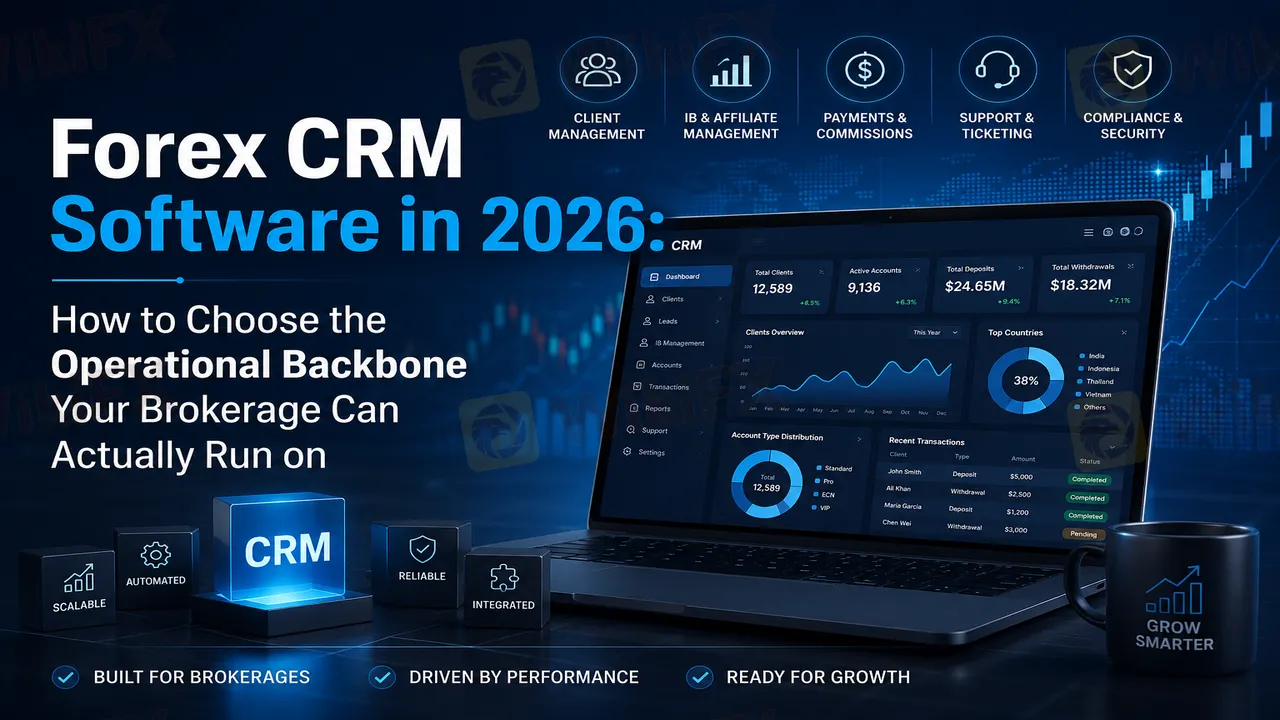
It is week three after launch. The MT5 environment is live, the FX liquidity provider is connected, the spreads look reasonable on the chart, and the first clients have funded. Then the operations team opens a shared spreadsheet and a Slack channel, and a quiet list of problems starts to surface. The compliance officer cannot reproduce a single client's full onboarding history without three logins. The finance team has spent four hours reconciling one day's deposits because the PSP webhook and the trading platform each tell a slightly different story. The IB manager is calculating commissions by hand because the platform's reporting does not match the affiliate tier the broker promised in marketing. A regulator's routine inquiry arrives; the broker's response takes nine business days. None of these problems are trading problems. They are operational problems, and they are the ones a forex CRM software is supposed to solve.
That is the central decision behind a forex CRM software in 2026. The platform answers the question “can the client trade?” The liquidity provider answers the question “can the order be filled?” A crm for forex brokers is supposed to answer the harder, longer-running questions: who is the client, are they allowed to trade here, are they paid correctly, can the broker evidence the answer, can the operations team handle the next 1,000 clients without doubling headcount, and can the broker leave on agreed terms if the relationship does not work. A credible CRM decision treats the system as an operating dependency that will be touched by every team, every regulator, and every audit, for the next several years.
 Contents
Executive Takeaways
· Treat the forex CRM software choice as an operational and regulatory decision, not a UX or pricing decision.
· The CRM's value is not its dashboard; it is whether it can keep client data, KYC evidence, payment states, IB logic, and reporting consistent across teams, regulators, and audits.
· A crm for forex brokers must integrate cleanly with the trading platform (MT4, MT5, cTrader, Match-Trader, TickTrader, DXtrade, Fortex, or another) and with the chosen payment service providers, or it becomes a parallel ledger that drifts.
· IB and affiliate logic is one of the most underestimated CRM requirements; commission rules, tier overrides, and clawbacks must be modelled before signing, not after the first quarterly payout.
· Data ownership, regulatory reporting exports, and exit rights belong in the contract, not in the relationship.
· For a 2026 broker, the right CRM is the one the operations, finance, and compliance teams can actually run on day one, day ninety, and day three hundred sixty-five, not the one with the most demo screens.
1. Why the Operations Gap Usually Appears in Week Three

Editorial image: brokerage leadership team reviewing CRM scope, KYC scope, and operational accountability.
Most brokers select a CRM in week one, before the first client funds. That timing is reasonable. The mistake is selecting a CRM as if the only week that matters is week one. The platform can look complete in a demo. The PSP integration can look complete in a sandbox. The IB tier logic can look complete on a slide. The first real test is when the broker has actual clients, actual payment exceptions, actual KYC resubmissions, actual withdrawal delays, and a regulator or auditor asking for evidence.
The operations gap usually appears in week three because that is when three things converge: real client data starts to flow, real payment edge cases appear, and the IB and finance teams try to close the first reporting period. A CRM that was selected for its onboarding screens tends to crack on reconciliation. A CRM that was selected for its reporting tends to crack on day-to-day client operations. A CRM that was selected for its integration catalogue tends to crack on ownership of client data. The right question is not “which CRM looks best in a demo?” It is “which CRM still looks coherent on day ninety under the broker's actual scope?”
Composite scenario: The Spreadsheet That Became the Real CRM
This scenario is illustrative, not a customer case study. A broker launches on a popular CRM, but the operations team finds that two key workflows (multi-tier IB commission with retroactive corrections, and PSP-specific deposit state mapping) are not natively supported. Rather than escalate the gap, the team builds a shared spreadsheet that mirrors the platform's data and the PSP's data side by side. Six months later, the spreadsheet is the operational source of truth; the CRM is the system of record. A routine audit reveals a reconciliation gap of three basis points on net deposits over the period. The broker cannot easily evidence which system was the source of truth for which date, and the operations team is asked to rebuild history from raw PSP exports.
The lesson is not that the CRM was wrong. The lesson is that a CRM whose gaps get filled by parallel tools eventually loses ownership of the operating model.
**Common operating mistake:** allowing a parallel spreadsheet, a side database, or a shadow workflow to become the de facto CRM. Every parallel layer creates a reconciliation gap, an audit gap, and a future migration cost.
Key Takeaways: The CRM Must Own Day Ninety, Not Just Day One
· “Good enough for launch” is not the same as “good enough to operate at scale”.
· The first reconciliation break, the first IB dispute, and the first KYC re-verification cycle will reveal the CRM's real coverage.
· A CRM that cannot be the source of truth for client, payment, and IB data on day ninety will not be the source of truth on day three hundred sixty-five.
2. What a Forex CRM Actually does — And What It does Not
A forex CRM software is the operational system that sits between the trading platform, the liquidity layer, the payment service providers, the KYC/AML vendors, the IB and affiliate channel, the finance team, and the regulator. In practice, the broker's experience of a CRM is shaped by eight elements: client onboarding and KYC, payment and withdrawal handling, account and trading-state visibility, IB and affiliate logic, reporting and exports, regulatory and audit readiness, integration with the platform, and the commercial and data-ownership terms wrapped around them. The brochure usually emphasises the first two. The operating reality is usually determined by the remaining six.
| Functional Area | Usually in Scope | Often Outside the Headline Scope |
| Onboarding and KYC | Form builder, document upload, basic ID checks | Re-verification cycles, PEP/sanctions screening depth, jurisdiction-specific forms |
| Payments | Standard PSP connections, deposit and withdrawal states | Multi-PSP reconciliation, chargeback handling, payment-method-specific fee logic |
| Trading-state visibility | Read-only client account, balance, equity, open positions | Real-time margin call, partial close, negative balance handling at the CRM layer |
| IB and affiliate logic | Standard multi-tier commission, basic rebate rules | Retroactive corrections, clawbacks, sub-IB hierarchies, cross-account attribution |
| Reporting and exports | Standard finance and operations reports | Regulator-specific exports, audit-ready evidence packs, multi-period reconciliation |
| Regulatory and audit readiness | Role-based access, basic activity log | Tamper-evident audit trail, data residency controls, regulator-mandated reporting formats |
| Platform integration | MT4/MT5 Manager API, cTrader/CTrader APIs, common bridges | Custom platform integration, multi-platform routing, cross-platform client identity |
| Commercial and data terms | Per-user pricing, monthly minimum | Data export, post-termination tail, data residency, and the broker's right to take operational data with it |
Composite scenario: A “Complete” CRM That Could Not Produce an Audit Pack
An illustrative broker accepts a CRM pitch that promises “complete client lifecycle management”. Six months in, a routine compliance audit asks for a full evidence pack on one client: the original onboarding form, the ID documents, the KYC decision, the funding sources, the trading pattern, the withdrawal requests, the support tickets, and the closure reason. The CRM has most of the data, but not in a single coherent export. The team spends two weeks stitching exports from the CRM, the platform, the PSP, and the support tool. The audit still flags the gap as a control weakness.
**Common operating mistake:** treating CRM as a workflow tool rather than an evidence tool. A CRM that cannot produce a regulator-ready evidence pack on one client cannot produce one on a thousand.
Key Takeaways: Due Diligence Depth, Not Just Feature List
· A forex CRM software pitch is a starting brief, not a substitute for a written functional and contractual scope.
· Confirm, in writing, the audit trail, the data export, the regulator-reporting formats, and the IB logic edge cases.
· Make data ownership, residency, and exit terms contract terms, not relationship expectations.
3. Standalone CRM, Integrated Suite, or Back-office Replacement: Pick the Accountability Model
The most important comparison among CRM options is not “which one has the most screens?” It is “which party controls each material workflow?” A standalone forex CRM software can be right for a broker that wants a defined operational perimeter and a clear vendor boundary. An integrated suite (CRM plus back-office plus IB plus reporting from a single vendor) can suit a broker that wants fewer hand-offs and a single contract. A back-office-replacement approach, where the broker builds or extends a system of its own around the trading platform, can be appropriate for mature brokers with the technical and compliance capacity to own the integration layer. Each path requires a different evidence pack, a different reporting cadence, and a different exit story.
| Decision Area | Standalone Forex CRM | Integrated Vendor Suite | Broker-Built or Back-Office-Replacement |
| Client and KYC ownership | Vendor's CRM is the system of record | Vendor's suite is the system of record | Broker's system is the system of record |
| Integration count | Many; each integration is a contract and a failure point | Fewer; one vendor contract covers most hand-offs | Broker owns the integration layer end-to-end |
| Time to first client | Fast if integration catalogue is mature | Fast if scope is standard | Slow; needs internal engineering capacity |
| Customisation ceiling | Constrained by vendor's roadmap | Constrained by vendor's suite logic | High; broker can shape any workflow |
| IB and affiliate logic | Standard multi-tier; edge cases need workarounds | Suite logic is consistent across modules | Broker can model any rule |
| Reporting and audit | Vendor formats; export limits vary | Suite reports are internally consistent | Broker can produce any export, but is responsible for its accuracy |
| Regulatory and audit risk | Concentrated in one vendor | Concentrated in one vendor | Distributed across broker's own controls |
| Exit and portability | Defined by the vendor contract | Defined by the suite contract; can be heavier to leave | Broker owns its data; exit cost is internal |
| Best fit | Mid-stage brokers that want speed and a defined perimeter | Brokers that prioritise one-vendor accountability and standard scope | Mature brokers with engineering, compliance, and finance capacity to own the layer |
Composite Scenario: Choosing a Suite without Mapping the IB Logic
An illustrative broker selects an integrated suite because the pitch promises “one contract, one report, one support team”. The suite's standard multi-tier IB logic does not match the broker's marketing promise of retroactively corrected tiers and cross-account attribution. The IB manager asks for a customisation. The vendor's professional services quote is significant; the timeline is three months. The first quarterly payout uses a manual workaround. The IB channel grows more slowly than projected.
The lesson is to choose the architecture whose standard scope already matches the broker's marketing commitments, not the one that needs the most customisation to get there.
**Common operating mistake:** choosing a CRM or suite for its demo polish, then discovering that the operational rules the broker actually promised (IB tiers, fee waivers, multi-account structures, regional pricing) are “professional services” add-ons.
Key Takeaways: Accountability First
· Match the CRM architecture to the broker's actual operating scope and team capacity, not to the most ambitious brochure.
· Ask the vendor the same five questions you would ask any operational dependency: who owns the data, who owns the export, who owns the audit trail, who owns the change, and who owns the exit.
· A more sophisticated CRM is only better if the operations, finance, and compliance teams can still use it on a Monday morning.
4. Turn a CRM Demo into an Operational and Audit Test

Conceptual workflow: a controlled forex CRM evaluation, audit-evidence test, and integration plan.
A CRM pitch is usually presented as an onboarding flow, a few dashboards, and a few screenshots. None of those answer the questions that matter after a regulator's inquiry. Replace a generic demo with a scenario-based session attended by operations, finance, compliance, technology, support, and IB management. The group should see normal cases, exception cases, and a controlled change. The aim is to verify behaviour under the broker's specific scope, not the vendor's generic narrative.
Scenario A: A Typical Client Onboarding to First Funded Trade
Walk through a new client from registration, identity upload, KYC decision, account creation, first login, first deposit, first trade, first IB attribution, and first support contact. At each point ask: which system is the source of truth; what does the client see; what does the operator see; what is logged; who can correct it; and how is the IB attribution recorded.
Scenario B: A Payment Exception and a Withdrawal Request
Introduce a realistic but controlled exception: a partial deposit, a PSP-side review, a chargeback, a withdrawal that requires enhanced due diligence, or a multi-currency conversion. Observe how the CRM records the state, how it communicates to the client, how it routes to the operations team, how the IB attribution is adjusted, and how the finance team reconciles at the end of day.
Scenario C: An IB Commission Recalculation
Ask the vendor to walk through a retroactive tier change, a clawback after a chargeback, a sub-IB override, and a cross-account attribution rule. Confirm whether these are standard, configurable, or custom development. Ask for a written rule sheet the broker can hand to its auditors.
Scenario D: A Regulator-Style Evidence Request
Ask the vendor to produce, in a single coherent export, the full evidence pack for a single client over a defined period. The export should include onboarding, KYC decision, deposit and withdrawal history, trading activity summary, support interactions, and any restrictions or escalations. If the export requires multiple stitched files, the CRM is not yet the system of record for that workflow.
Scenario E: A Contract and Exit Dry Run
Ask the vendor to walk through what an exit would look like: notice period, data export, post-termination tail, transitioning to another CRM, and the broker's continuing obligations to clients. The walkthrough is rarely pleasant. That is the point.
**Common operating mistake:** treating a CRM demo as a sales conversation instead of a due-diligence exercise. The same stakeholders who would notice an operational gap in production should be in the demo, asking the same questions they would ask the broker's own team.
Key Takeaways: Test the CRM, do Not Just Meet the Vendor
· Verify behaviour on the broker's onboarding flow, the broker's payment methods, the broker's IB structure, and the broker's reporting cadence.
· The best proof is a single coherent evidence export, a written IB rule sheet, and a written exit path, not a polished demo.
· A crm for forex brokers that cannot articulate a regulator-ready export is signalling that the broker's evidence obligations will be the broker's problem, not the vendor's.
5. The Integration Layer: Platform, PSP, KYC, IB — And Where the Data Must Live
The CRM does not operate alone. It sits between the trading platform, the PSPs, the KYC/AML vendors, the IB and affiliate channel, the marketing system, the support tool, and the finance system. Each of those connections is a place where data can drift if the CRM is not the explicit source of truth. For a 2026 broker, the meaningful question is not “how many integrations does the CRM support?” It is “which system is the source of truth for which event, and what happens when two systems disagree?”
| Connection | What Must be True | What to Challenge in Writing |
| Trading platform (MT4, MT5, cTrader, Match-Trader, TickTrader, DXtrade, Fortex) | The CRM's account, balance, and position view is consistent with the platform's state within an agreed tolerance | What happens on margin call, partial close, negative balance, account migration, multi-platform routing |
| Payment service providers | The CRM's deposit and withdrawal state matches the PSP's state, including partial, pending, and failed events | How chargebacks, refunds, fees, FX conversions, and PSP outages are reflected in the CRM and in finance reports |
| KYC/AML vendors | The CRM's KYC decision reflects the vendor's screening result, with audit trail | Re-verification cadence, PEP/sanctions refresh, jurisdiction-specific document handling, and the vendor's role vs the broker's role |
| IB and affiliate system | The CRM's IB attribution, tier, and commission calculation match what the IB was promised in marketing | Retroactive corrections, clawbacks, sub-IB hierarchies, cross-account attribution, and the time window for adjustments |
| Reporting and finance | The CRM's reports can be reconciled against the platform, the PSPs, and the ledger within an agreed tolerance | Period-close timing, multi-currency handling, fee and rebate logic, and the broker's ability to lock a period |
| Support and ticketing | The CRM's client view includes support history, restrictions, and escalations | What is logged, who can change it, how long it is retained, and how it is exported for a regulator |
Composite Scenario: Two Systems That Disagreed About a Deposit
An illustrative broker connects a CRM and a PSP. The PSP's webhook reports a successful deposit of USD 1,000. The CRM's deposit state remains “pending” for twelve hours due to a delayed reconciliation job. A client requests withdrawal; the operations team declines because the CRM says the funds are not yet available. The client complains; support escalates; the broker processes the withdrawal manually. A week later, the reconciliation is corrected, but the IB attribution was never updated, so the IB's first commission statement under-reports the deposit. The IB disputes the statement.
The lesson is that the CRM is only as good as its weakest connection, and that the connection's failure mode must be designed for, not discovered in production.
**Common operating mistake:** treating integration as a one-time project. Integration is a continuous operating dependency. Every PSP, KYC, and platform upgrade is a moment when the CRM's source-of-truth claim can quietly fail.
Key Takeaways: The CRM Must Own the Source of Truth
· Choose the CRM whose default architecture treats it as the system of record, not as a parallel dashboard.
· Confirm, in writing, the tolerance, the reconciliation cycle, and the failure-handling rules for each connection.
· A 2026 broker should be able to name, for each event type, which system is the source of truth, what is logged, and how a regulator would see it.
6. Forex CRM Cost: Model the Lifecycle, not the Per-Seat Headline
Searches for best forex crm or forex crm pricing often expect one public number. In practice, the cost of a forex CRM software relationship is a structure: per-user or per-account pricing, integration fees, professional services for customisation, KYC/AML pass-through costs, support tier, training, data export, and the cost of any required migration. The headline is the smallest decision; the structure is the largest.
For decision-making, build a commercial model with at least these lines:
| Cost Line | What to Capture | What to Challenge in Writing |
| Per-user or per-account fee | Pricing model, included users or accounts, growth tiers | Behaviour on sudden client growth, internal user growth, IB user access |
| Platform integration | Manager API licence, custom integration, bridge or middleware | Renewal terms, upgrade responsibility, who owns the integration on platform upgrades |
| KYC/AML and screening | Per-check or subscription pricing, document storage, PEP/sanctions | Re-verification cadence, jurisdiction-specific document handling, audit trail cost |
| Payments and PSP connections | Standard integrations, custom PSP work, multi-currency handling | Chargeback handling, fee logic, refund flows, multi-currency conversion |
| Customisation and professional services | IB logic, reporting, jurisdiction-specific forms | What's included, what's billable, what's best-effort, typical change-request timeline |
| Support and uptime | Hours, severity levels, named contacts, response and resolution SLAs | Penalty structure, what counts as downtime, escalation path |
| Data and residency | Data storage, regional residency, encryption, retention | Cross-border data movement, retention beyond termination, audit access |
| Migration, exit and tail | Onboarding data migration, training, exit data export | Format, scope, time window, post-termination access, and the cost of leaving |
**Common operating mistake:** negotiating the per-seat fee while ignoring the structure around it. A low per-seat fee with weak integration coverage, expensive customisation, and unclear data ownership can cost a broker more than a slightly higher fee with a strong integration catalogue and clean export.
Composite Scenario: The “All-in” Fee That Quietly Excluded IB Logic
An illustrative broker accepts an “all-in” CRM fee that promises a low monthly total. Six months in, the IB team needs a retroactive tier correction, a sub-IB hierarchy, and a custom cross-account attribution rule. Each is quoted separately as professional services. The broker's all-in cost has doubled, and the IB channel's launch has been delayed by two reporting periods.
Key Takeaways: Structure Beats Headline
· Build the cost model line by line, in writing, before signing.
· Treat the integration catalogue, the KYC/AML scope, the IB logic, and the exit terms as cost lines, not as afterthoughts.
· A 2026 broker should be able to articulate why each cost line exists and what behaviour change would justify changing it.
7. A 2026 Integration Timeline That Does Not Assume Everything Will Go Right
The integration of a forex CRM software is the most underestimated part of a CRM decision. Marketing language usually implies weeks. Realistic timelines, including KYC integration, PSP connection, IB logic, reporting, and regulator-style evidence testing, are often three to six months for a new CRM and two to four months for a CRM replacement. The timeline below is a working baseline, not a commitment.
| Phase | Indicative Duration | What Must be True to Move on |
| Pre-contract diligence | 2–4 weeks | Written scope, written data-ownership terms, written exit terms, references reviewed |
| Legal, data, and KYC | 3–6 weeks | Data processing agreement signed, KYC vendor connected, jurisdiction review completed |
| Platform and PSP integration | 4–8 weeks | Manager API or bridge spec confirmed, sandbox PSP connected, latency and state tolerance measured |
| IB and affiliate logic | 2–6 weeks | IB tier rules modelled in writing, retroactivity and clawback behaviour tested |
| Internal testing | 2–4 weeks | Test plan covers onboarding, KYC, payments, IB, reporting, and at least one regulator-style evidence request |
| Reporting and reconciliation | 2–4 weeks | Reports reconciled against the platform, the PSP, and the ledger within an agreed tolerance |
| Pilot and rollout | 4–6 weeks | Limited client cohort, monitored operations, support readiness, rollback conditions |
| Steady-state review | Continuous | Quarterly operational review, annual contract review, exit readiness check |
**Common operating mistake:** skipping the IB and reporting phases because the CRM “supports standard formats”. IB logic and regulator-style reporting are not formats; they are operating cycles. The broker's quarterly close and the broker's first regulator inquiry will surface the gap.
Key Takeaways: Timeline Discipline
· Build the timeline backwards from the first day the broker's client interacts with the CRM in production, not forwards from the contract signature.
· Each phase has a documented exit; if a phase slips, the next phase should not be compressed.
· A 2026 broker should be able to name, for each phase, the owner on the broker side and the owner on the CRM side.
8. Frequently Asked Questions (FAQs)
What is a forex CRM software?
A forex CRM software is the operational system that sits between a broker's trading platform, liquidity layer, payment service providers, KYC/AML vendors, IB and affiliate channel, finance team, and regulator. It owns client onboarding, KYC decisions, payment states, IB attribution, reporting, and the audit trail. The most useful way to think about a CRM is as a combination of a system of record, operating workflow, audit-evidence source, and contract with the vendor — not as a dashboard.
What should a 2026 broker look for in the best forex CRM?
The best forex crm for a 2026 broker is the one whose default scope already matches the broker's operating model. Look for: clean integration with the chosen trading platform (MT4, MT5, cTrader, Match-Trader, TickTrader, DXtrade, Fortex, or another), configurable IB and affiliate logic that supports retroactive corrections and clawbacks, KYC/AML scope that matches the broker's jurisdictions, regulator-style evidence exports, clear data ownership and data residency terms, and a written exit path. A demo is a starting point, not a substitute for any of these.
How does a CRM integrate with MT4, MT5, cTrader, Match-Trader, TickTrader, DXtrade, or Fortex?
Most modern CRM vendors expose a Manager API or a bridge connector for the major platforms. The integration typically allows the CRM to read client account state, create or modify accounts, trigger password resets, and reconcile balances. The right way to evaluate the integration is not “is there a connector?” but “what is the connector's state tolerance, reconciliation cycle, and failure mode on platform upgrades?” A connector that drifts on a platform upgrade is a quiet source-of-truth risk.
What is the typical cost of a forex CRM?
There is no single answer. Pricing models include per-user, per-account, per-region, and bundled. The total cost depends on the integration catalogue, the KYC/AML scope, the IB logic customisation, the support tier, the data residency, and the exit terms. Build the model line by line, in writing, before signing, and treat the integration, the KYC/AML, and the exit as cost lines, not as afterthoughts.
How does a CRM support IB and affiliate commissions?
A forex CRM software typically supports multi-tier commission calculation, basic rebate rules, and standard affiliate dashboards. The right way to evaluate IB support is to ask: can the CRM model the broker's actual IB promises, including retroactive tier changes, sub-IB hierarchies, cross-account attribution, and clawbacks after chargebacks? If those require custom development, the cost and the timeline should be in the contract, not in a follow-up quote.
How does a CRM support KYC/AML?
A CRM typically supports onboarding forms, document upload, ID checks, and PEP/sanctions screening through integrated vendors. The right way to evaluate KYC/AML is to ask: how does the CRM handle re-verification, jurisdiction-specific document types, PEP/sanctions refresh cadence, enhanced due diligence triggers, and the audit trail for each KYC decision? The CRM's value is not the initial check; it is the broker's ability to evidence every decision over time.
How does a CRM handle payments and withdrawals?
A CRM typically connects to PSPs through standard integrations, with the CRM recording deposit and withdrawal states, routing exceptions, and producing reconciliation reports. The right way to evaluate payment handling is to ask: how does the CRM handle partial deposits, pending states, chargebacks, refunds, multi-currency conversions, PSP outages, and fee logic? Each of these is a place where the CRM's source-of-truth claim can quietly fail.
Can a broker replace its CRM later without losing client data?
In principle, yes; in practice, only if the original contract included a written exit path with a defined data export format, scope, and time window. Without that, the broker's exit cost can be material. Treat data ownership, data export, post-termination tail, and the cost of leaving as core commercial terms, not as boilerplate.
What is the difference between a forex CRM and a forex back office?
A forex CRM is the operational system that owns client-facing workflows (onboarding, KYC, payments, IB, support). A forex back office software is the system that owns finance, reporting, reconciliation, and audit workflows. In practice, the two overlap heavily, and most 2026 brokers either buy an integrated suite that covers both, or run a CRM with a separate finance system that is reconciled against the CRM. The right answer depends on the broker's team capacity and regulatory expectations.
How does a CRM support a broker's regulator or auditor?
A CRM supports a regulator or auditor by being able to produce, in a single coherent export, the full evidence pack for any client over any defined period: onboarding, KYC decision, funding, trading, withdrawals, support, restrictions, and closure. If the CRM cannot produce that export, the broker's audit and regulatory responses will be slower, more expensive, and less reliable than they need to be.
9. Conclusion and Checklist
Choosing a forex CRM software in 2026 is an operational and regulatory decision, not a procurement one. The right CRM is the one the broker can run on day one, day ninety, and day three hundred sixty-five, and the one the regulator, the auditor, and the IB channel can also work with. That usually means a clear source-of-truth architecture, a written integration scope, a written KYC/AML scope, a written IB logic scope, a working reconciliation cycle, a regulator-ready evidence export, and a written exit path. Anything less converts a CRM into a parallel ledger that drifts.
Use this checklist before signing or extending a CRM relationship:
· [ ] Onboarding, KYC, payments, IB, reporting, and audit-trail behaviour is defined in writing, per workflow and per jurisdiction.
· [ ] The architecture (standalone CRM, integrated suite, or broker-built) is matched to the broker's team capacity and operating scope.
· [ ] Integration with the trading platform, the PSPs, the KYC/AML vendors, and the IB system is documented, with tolerance, reconciliation cycle, and failure mode captured in writing.
· [ ] IB and affiliate logic, including retroactivity and clawbacks, is modelled in writing and tested before contract signature.
· [ ] Regulator-style evidence exports have been tested on at least one real client, not only on synthetic data.
· [ ] Data ownership, data residency, audit access, and the cost of leaving are captured in the contract, not in a relationship expectation.
· [ ] A replacement CRM or suite is on a defined roadmap, with a budget, an owner, and a timeline.
· [ ] The operations, finance, and compliance teams have signed off on the CRM as the system of record for their respective workflows.
**Closing note:** A **crm for forex brokers** A relationship is one of the longest commitments a broker makes. Spend the same diligence effort on the integration, the KYC/AML, the IB logic, the regulator-style evidence export, and the exit path as on the per-seat fee. That is the difference between an operational backbone and a parallel ledger.
Download the WikiFX app for the latest forex updates.

Knowledge pays at WikiFX.Every time you share a WikiFX article, you'll receive 50 Reward Points. Grow your rewards with every share and unlock exclusive gifts in the WikiFX Points Mall. Start earning today!

Interesting Articles for You
Launches GOLD24-7: Weekend Gold Trading Goes Live Review 2026: Users Report Disturbing Withdrawal Issues - Is the Broker Still Reliable? Review 2026: Why Some Users Report Withdrawal Problems - and What the Evidence Shows

Disclaimer:
The views in this article only represent the author's personal views, and do not constitute investment advice on this platform. This platform does not guarantee the accuracy, completeness and timeliness of the information in the article, and will not be liable for any loss caused by the use of or reliance on the information in the article.
WikiFX Broker
Latest News
Apple Faces Lawsuit Over Fake Crypto App Exposing $1.8 Million Theft
WikiFXTrump Memecoin Faces SEC Scrutiny After Nearly One Million Investors Suffer Heavy Losses
WikiFX"They Want to See Your Face": Inside ATFX Cambodia's Rise
WikiFXSpread Cheating: The Invisible Trading Cost That Could Be Working Against You
WikiFXLevels Review: No Regulation and Mounting Withdrawal Complaints – What Traders Need to Know
WikiFXLQH MARKETS Review: Multiple Traders Report Withdrawals Blocked and Accounts Terminated
WikiFXBorn2trade Adds Copy Trading to 1:5000 Leverage Platform
WikiFXPILOTFX Review: What Traders Should Know Before Depositing
WikiFXLMAX Group Review 2026: Users Report Disturbing Withdrawal Issues - Is the Broker Still Reliable?
WikiFXTrade24Seven Review: What Traders Should Know Before Depositing
WikiFX