

Global Broker Regulation Inquiry App
About WikiFX
English
简体中文
繁體中文
English
Pусский
日本語
ภาษาไทย
Tiếng Việt
Bahasa Indonesia
Español
हिन्दी
Filippiiniläinen
Français
Deutsch
Português
Türkçe
한국어
العربية
اردو


A Losing Streak Hijacks Your Judgement. Here's a 4-Step Reset

WikiFX
|


Abstract:A losing streak can hijack judgement and fuel revenge trading or freezing. This beginner-friendly guide explains the stress loop and shows a four-step mental reset for rebuilding decisions.
Many beginners can handle one losing trade. A losing streak, a run of several losses in a row, is a different test. It changes the way the brain weighs risk, not just the balance in the account. That reaction is normal, not a character flaw.
The word “streak” is a clue: the brain treats a series as a pattern. It starts looking for a way to stop the pattern, which makes a trader rush. The rush is where clear judgement slips away.
 Contents
The Stress Loop Behind Revenge Trading and Freezing
The pressure loop usually starts in the amygdala, a small part of the brain that scans for danger. To the amygdala, several losing trades can look like a physical threat. Stress hormones rise, attention narrows, and the mind starts hunting for evidence that supports the fear. That creates a loop: fear produces urgency, urgency produces a hasty trade, and the hasty trade often adds to the loss.
Two stress patterns fit that loop. Revenge trading is increasing the size of the next trade to win back what was lost. Freezing is the opposite: a trader hesitates on a setup, in other words, a planned entry they would normally take, then watches the market move without them. Both look like separate problems, but the cause is the same: stress has taken over the decision.
Here is a fictional teaching example, not a real trading story. Suppose a beginner called Amara keeps her usual risk at 1% of a 10,000 USD account, or 100 USD per trade. She loses four small trades in a row, so the account drops by about 400 USD. The emotional tug tells her to make the loss back quickly. She takes a fifth trade and risks twice her usual amount, 200 USD. That trade also moves against her, and the combined loss for the day reaches roughly 600 USD, about 6% of the starting account. The market price does not matter; the pattern is what matters.
Psychologists call the deeper force loss aversion: a loss hurts roughly twice as much as an equal gain feels good. That imbalance is why a small loss can feel huge and why the urge to “make it back” is strong. Recognising this pattern is the first step toward rebuilding decisions.
Rebuilding the Decision Process
Decision rebuilding starts away from the charts. The goal is to separate the emotional state from the routine used to evaluate a trade. It does not require a special indicator or a secret rule. The idea is to make the choices before a trade more boring and repeatable.
One practice some traders describe is a short written check-in before a trading session begins. At a simple level, that check-in covers three questions: how they slept, how they feel about the last five trades, and whether they are hoping to “make it back”. In that practice, a yes to the third question acts as a reason to pause. The pause is a reminder, not an order to change trade size.
Another tool in the same educational toolkit is pre-commitment, meaning a decision about loss limits made while calm. Some traders set the number of losses they will accept in a week. For a hypothetical example, one made-up limit could be: two losses in a day, then stop for the day; three losses in a week, then stop for the week. The lesson is not the exact number but the timing of the decision. This is a teaching example, not a rule for anyone to copy exactly.
Journaling, or writing down decisions and emotions after each session, is also common in trading-psychology discussions. The journal does not have to be about profit and loss only. A trader can record the stress level on a scale from 1 to 10, whether position size, the amount put at risk in one trade, changed after a loss, and whether they entered a trade that was not planned. After a few weeks, patterns become visible.
A Simple Self-Check for Recovery Mode
The four-step reset below is one way trading psychologists describe separating stress from analysis. It is not a buy or sell signal. It is meant as a mental pause before the next decision.
- Notice: A trader notices the physical signs: a faster heartbeat, tight shoulders, or the feeling that something must be done right now.
- Name it: They tell themselves, “This is stress, not a setup.”
- Pause: They step away from the desk for at least 15 minutes. The delay is the core of the reset.
- Choose: They return to the charts only when the need for speed has faded. The choice is to wait for a calmer mental state, not to follow impulse.
To track whether this kind of reset works, a trader might review the journal once a week and look at one measure: how many trades they took while their recorded stress level was 7 or higher. Weeks with fewer of those trades are usually calmer. The aim is not to feel zero stress. The aim is to stop stress from deciding which trades happen.
Rebuilding a mental process takes repetitions. A single calm day after a losing streak does not mean the pattern is gone. The next streak will test it, and that is normal. What matters is that a loss can teach something about the trader's own process, not just about the market.
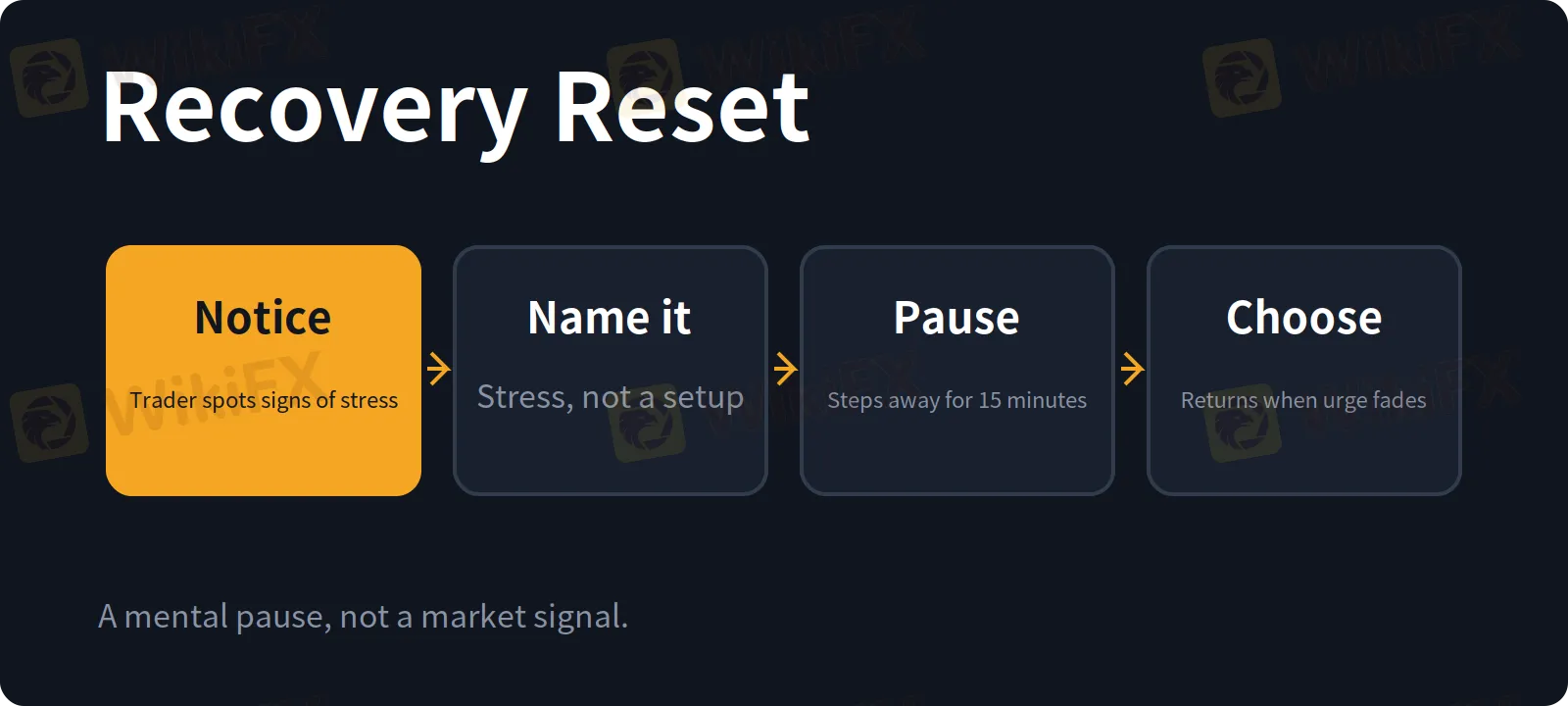
A four-step mental reset for recovery mode.
Disclaimer:
The views in this article only represent the author's personal views, and do not constitute investment advice on this platform. This platform does not guarantee the accuracy, completeness and timeliness of the information in the article, and will not be liable for any loss caused by the use of or reliance on the information in the article.
WikiFX Broker
Latest News
Plus500 Joins Bahamas Forex and CFD Industry Association
WikiFXNigeria's net FX flow falls 29% to $4.94bn in March
WikiFXDFSA warns of scam impersonating firm Menhir Capital
WikiFXFiji-deported man faces charges in $165M crypto Ponzi
WikiFXWhy Fake Screenshots Make You Feel Like a Losing Trader
WikiFXKATOPRIME Review: Regulation Gaps and Broker Risks Traders Cannot Ignore
WikiFXWHITEFOREX Review: Is Your Deposit Safe?
WikiFXLQH Markets Review: Unregulated Broker With Growing Withdrawal Complaints
WikiFXSpec Capital Group Secures ASIC Licence for Wholesale CFD Services
WikiFXExclusive Capital Review: Regulated by CySEC, but Traders Report Withdrawal Problems
WikiFX