Abstract:India's Q1 FY27 GDP grew 7.8%, beating a 7.4% poll and RBI's 7.0% projection. See three conditional scenarios for INR, rates and gold.
 Contents
Bottom Line
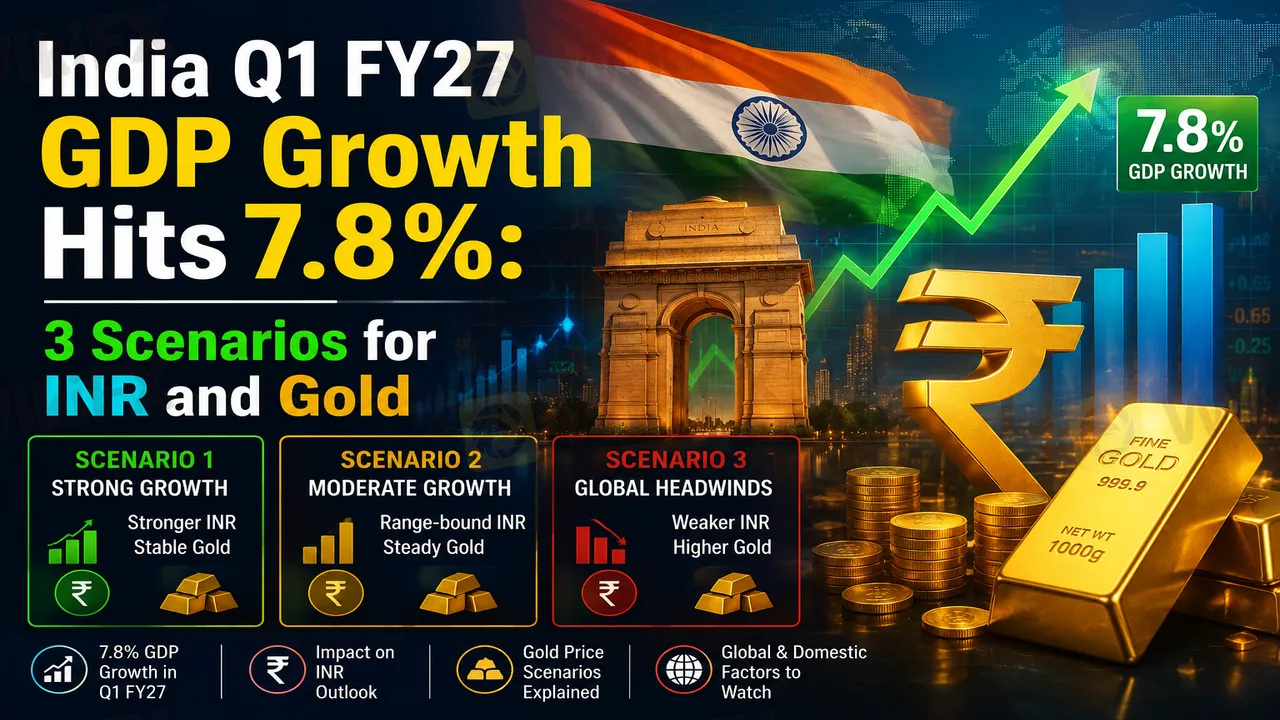
India Q1 FY27 GDP growth reached 7.8% year on year in April–June 2026, according to the Ministry of Statistics and Programme Implementation release posted at 4:00 pm IST on 31 August. Real GDP was estimated at ₹81.36 lakh crore, up from ₹75.46 lakh crore a year earlier, while nominal GDP rose 10.3% to ₹88.27 lakh crore. The outcome was above the 7.4% median in a Mint poll of 21 economists and the RBI's 7.0% quarterly projection. For the USD/INR outlook, the surprise is potentially supportive for the rupee, but oil prices, inflation, global dollar moves and capital flows can dominate the growth effect.
What Happened in the 31 August GDP Release?
The India GDP data show real gross value added of ₹73.82 lakh crore, compared with ₹68.21 lakh crore in Q1 FY26, giving 8.2% growth. Nominal GVA rose 11.5% to ₹80.53 lakh crore. Independent post-release analysis from ICRA compared the 7.8% GDP result with its 7.0% forecast and the revised 8.6% expansion in Q4 FY26. This means the economy beat expectations but slowed from the previous quarter, two facts that should be kept together rather than turned into an exaggerated boom headline.
The release uses India's new national-accounts series with base year 2022–23. MoSPI says updated quarterly estimates now incorporate the new Producer Price Index, a rebased Index of Industrial Production and additional administrative data. It also applies double deflation to manufacturing, separately adjusting output and intermediate inputs. As a result, traders should avoid comparing the new figure mechanically with older-series numbers without checking whether the basis is consistent.
Why the 7.8% Result Matters for INR, Rates and Gold
A stronger-than-expected economy can support the rupee by improving growth confidence and attracting capital. It can also reduce the urgency for the RBI to cut rates, especially if inflation or imported energy costs are elevated. Higher relative yields may help INR at the margin. However, the RBI rate path depends on inflation, liquidity and financial conditions—not GDP alone—so the release does not guarantee a hold, hike or cut.
The expenditure and activity signals are mixed enough to require discipline. MoSPI's annexure shows exports of goods and services up 25.8% year on year and imports up 30.5%. Capital-goods output grew 15.2%, commercial-vehicle sales 18.3%, and major-port cargo 6.2%. At the same time, international air traffic fell 19.5%, fuel-mineral output declined 4.5%, and mining and quarrying output fell 1.2%. The growth surprise is broad evidence of resilience, but it does not remove external vulnerabilities.
For the gold price in India, the currency-translation effect matters. A firmer rupee can cushion domestic gold prices even if dollar gold rises, while INR weakness can lift local prices when the global metal is flat. Strong GDP can also change bond yields and risk appetite. Track USD/INR and international gold at the same timestamp, then add taxes, platform spreads and financing costs before judging a trade.
Three Market Scenarios After India Q1 FY27 GDP Growth
These are trigger-based scenarios, not price targets. A headline surprise should only change a position when market data confirms the channel.
- Scenario A — INR gains support. Trigger: foreign portfolio flows improve, Indian bond yields remain orderly, inflation stays compatible with the RBI's framework, crude oil does not surge, and USD/INR closes below a recent support level on normal spreads. The 7.8% result would then reinforce a growth-and-carry narrative.
-
- Scenario B — USD/INR consolidates. Trigger: stronger growth is balanced by firm oil prices, import demand and a steady global dollar. If spot repeatedly reverses within its recent range while RBI communication remains unchanged, traders should wait for a confirmed break rather than chase the release candle.
-
- Scenario C — INR weakens despite GDP. Trigger: crude rises sharply, global risk aversion drives capital outflows, or inflation data narrows RBI flexibility while the dollar strengthens. That outcome would show external funding and price risks outweighing the domestic growth surprise.
Five Checks for Indian Traders
- Verify the release time and base year. Use the MoSPI/PIB page dated 31 August and note that the estimates use 2022–23 prices.
- Separate actual, previous and expected: 7.8% actual; 8.6% revised previous quarter; 7.4% Mint poll; 7.0% RBI projection.
- Watch confirmation markets together: USD/INR, government-bond yields, crude oil, equity flows and the Dollar Index.
- For gold, calculate the INR conversion and full platform spread instead of copying a dollar-gold headline.
- Reduce leverage around RBI communication, inflation releases and the next GDP estimate; keep timestamped screenshots and predefined risk limits.
Conclusion: The Next Official Confirmation Matters
India Q1 FY27 GDP growth delivered a clear upside result: 7.8%, versus a 7.4% economist poll and the RBI's 7.0% projection. Real GVA grew 8.2% and nominal GDP 10.3%, but the quarterly pace was below the revised 8.6% in Q4. The best use of the data is therefore conditional: test whether flows, yields, oil and USD/INR confirm the stronger-growth interpretation. MoSPI has scheduled the Q2 FY27 GDP release for 30 November 2026. Before then, traders should focus on RBI decisions, inflation and external-balance data rather than treating one strong quarter as a guaranteed currency or gold direction.