

Global Broker Regulation Inquiry App
About WikiFX
English
简体中文
繁體中文
English
Pусский
日本語
ภาษาไทย
Tiếng Việt
Bahasa Indonesia
Español
हिन्दी
Filippiiniläinen
Français
Deutsch
Português
Türkçe
한국어
العربية
اردو


Beware of Romance Scams as Valentine’s Day Approaches | 'I Love You' Could Lead to Bankruptcy

WikiFX
|


Abstract:As Valentine’s Day approaches, many Malaysians searching for companionship online may unknowingly be stepping into a scam.
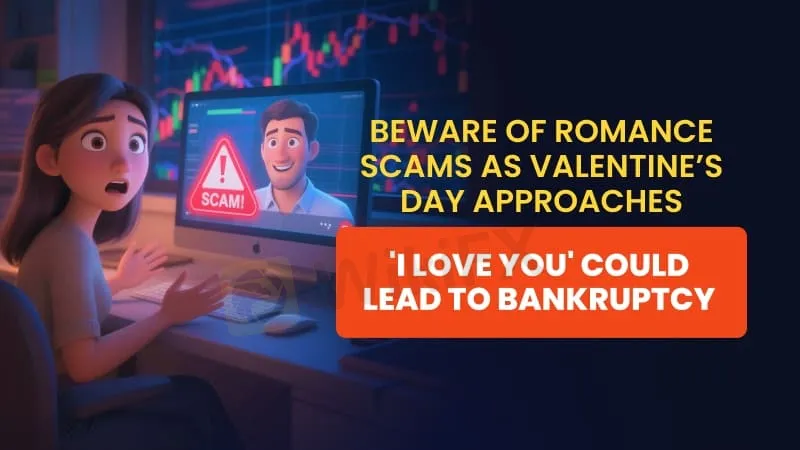
These schemes often begin on familiar platforms such as Facebook, Instagram, online games and dating applications. What starts as a casual conversation can slowly develop into what appears to be a sincere relationship. However, behind the screen may be a well-organised fraud network.
Artificial intelligence is now playing a central role in this evolution. According to Brian Long, an artificial intelligence fraud specialist and chief executive of Adaptive Security, technology allows scammers to craft highly personalised messages within seconds. In the past, fraudsters needed to manually research their targets to understand their interests and background. Today, AI tools can analyse public information and generate detailed, emotional messages almost instantly. This creates the illusion of deep understanding and genuine affection.
Scammers can now produce lengthy and heartfelt messages that appear thoughtful and intimate, even though they are generated in moments. The result is communication that feels authentic and tailored, making it increasingly difficult for victims to recognise deception.
Another shift is the patience of fraudsters. Rather than demanding money early in the interaction, many now build trust over months. Some may spend six to twelve months developing what seems like a close bond. By the time a request for money is made, the victim may feel emotionally invested and less likely to question the situation.
In Malaysia, authorities have repeatedly warned that romance scams remain one of the leading forms of online fraud. Police reports frequently show losses amounting to hundreds of thousands of ringgit, and in some cases exceeding RM1 million. Victims range from young professionals to retirees.
The most critical warning sign remains simple: a request for money. These requests are often disguised as urgent needs. The online partner may claim to face medical emergencies, business setbacks or travel problems. Increasingly, scammers introduce investment opportunities, particularly involving cryptocurrency or foreign exchange trading. They may promise high returns and offer to guide victims through the process.
Financial experts stress that it is always a red flag if someone you have never met asks you to buy gift cards, transfer funds between bank accounts or send cryptocurrency. Such payment methods are favoured because they are difficult to trace and reverse.
There are other common patterns. Scammers often claim to live or work overseas. They may present themselves as engineers on offshore oil rigs, international contractors or military personnel stationed abroad. Physical meetings are consistently postponed, with excuses that appear reasonable at first but persist indefinitely.
Emotional manipulation is another tactic. Fraudsters may declare love unusually quickly or speak about marriage and a shared future within weeks. They often emphasise trust and loyalty, framing financial assistance as proof of commitment. Some share stories of hardship to gain sympathy and lower their victims guard.
Investment-related romance scams are particularly concerning. International consumer watchdogs report that a significant portion of investment fraud cases begin with a fake romantic relationship. In Malaysia, similar patterns have been observed, with victims persuaded to invest in unlicensed platforms after being introduced by an online partner.
The growing use of AI has also blurred traditional warning signs. Poor grammar and awkward phrasing, once typical of scam messages, are less common. Technology now enables fraudsters to imitate natural speech patterns and even specific accents. Voice cloning and fabricated video content mean that phone and video calls can no longer be seen as definitive proof of authenticity.
Experts suggest that technology can also be part of the defence. AI tools can be used to analyse suspicious messages. By pasting conversations into reliable platforms and asking whether they show signs of manipulation or fraud, users may gain a more objective assessment. While not foolproof, this approach can provide an additional layer of scrutiny.
For Malaysian readers, the key lesson is caution. Verify identities through independent means. Conduct reverse image searches on profile photos. Check investment opportunities against Bank Negara Malaysia and Securities Commission Malaysia alerts. Most importantly, never transfer money to someone you have not met in person and verified thoroughly.
Romance scams succeed because they exploit emotion rather than logic. They rely on loneliness, trust and hope. Yet genuine relationships do not require secrecy, urgent payments or financial sacrifice.
As Valentines Day draws near, the promise of connection should not overshadow financial prudence. In the digital age, love may begin online, but common sense must remain firmly offline.
Disclaimer:
The views in this article only represent the author's personal views, and do not constitute investment advice on this platform. This platform does not guarantee the accuracy, completeness and timeliness of the information in the article, and will not be liable for any loss caused by the use of or reliance on the information in the article.
WikiFX Broker
Latest News
FXDD Malta Licence Ends: What Traders Need to Know
WikiFXPoland: Growth supported by investment rebound – ING
WikiFXSouth Korean Won: BoK tightening supports KRW against US Dollar – Commerzbank
WikiFXBreaking: Nonfarm Payrolls benchmark revision to lower US employment by 79,000 through March 2026
WikiFXDow Jones Industrial Average round-trips a Fed that promised nothing
WikiFXMexican Peso tumbles as Warsh embarks on inflation fight
WikiFXJapanese Yen dips further despite hotter inflation, upbeat employment data
WikiFXOEXN Broker Review: Regulated but is it Safe for Traders?
WikiFXSilver Price Forecast: False breakout and hawkish Fed sink XAG
WikiFXEC Markets Marketing Director Nick Xydas Steps Down
WikiFX