

Global Broker Regulation Inquiry App
About WikiFX
English
简体中文
繁體中文
English
Pусский
日本語
ภาษาไทย
Tiếng Việt
Bahasa Indonesia
Español
हिन्दी
Filippiiniläinen
Français
Deutsch
Português
Türkçe
한국어
العربية
اردو


What Your Trading Journal Really Reveals About Your Behaviour

WikiFX
|


Abstract:A trading journal is not a scorecard; it is a mirror. This guide shows beginners how to notice emotional triggers, repeated states and behavioural loops hidden in their own trade records, without telling you what to buy or sell.

Many beginners start a trading journal hoping to discover which setups, the chart patterns or conditions they use before deciding to trade, made money. After a few weeks, they have a long list of entries and still cannot explain why their results keep shifting. The journal was filled in, but it was never really read. The missing step is not more chart analysis; it is learning to read your own behaviour.
Forex is the global market where currencies are traded, and decisions often happen in seconds. A trading journal is a record of every trade you make. It becomes useful when it also captures what was happening in your head before you clicked the button to enter a trade. A behaviour pattern is a repeatable sequence of thoughts, feelings and actions that tends to end in a similar kind of outcome. Over time, sorting those records can show you the loop behind many of your trades.
 Contents
Start with Self-Observation, Not Self-Criticism
The natural response to a losing trade is to call yourself undisciplined. That label closes the investigation before it starts. Behaviour patterns are easier to see when you treat the journal as a detective's notebook, not a courtroom. Before analysing your results, capture the moment just before you decide to act. Keep the notes short; long entries get abandoned. A phrase such as 'rushed' or 'felt smart' is enough.
- The trigger. What happened just before you acted? A news headline, a profit alert on your phone, a message from a friend, or simple boredom?
- The state. What did you feel? Impatience, fear of missing out, anger, fatigue, or quiet confidence?
- The action. Did you follow the plan you made earlier, or did you change the amount you risked, the direction, or your stop-loss (the price you set to close a trade if it moves against you) at the last second?
- The aftermath. What did you do after the result? Did you pause, chase the market, close the app, or open another trade immediately?
The Loop Behind Repeat Trades
Here is a hypothetical teaching example to make the mechanism visible. It is not a real person's record and it is not a recommendation to trade. Imagine a beginner named Mei. She records the price she got in at, called the entry, the price she got out at, called the exit, and the final result of every trade. Her spreadsheet looks tidy. She notices a strange repeat: on days when her first trade ends in a loss, she opens another position, meaning another active trade exposed to the market, before lunch, even though her own plan says to wait.
Mei never writes down the urge to recover. Her journal shows the action but not the reason behind it. When she only reviews profit, she sees one version of the story. When she adds one line about her internal state, a different loop appears. She can see that a loss leads to an urge to recover, the urge leads to a rushed trade, and the rushed trade tends to produce another loss. The loop is already running before conscious thought gets a vote. Naming it does not tell her whether the next position should be larger or smaller. It tells her which part of the decision needs attention.
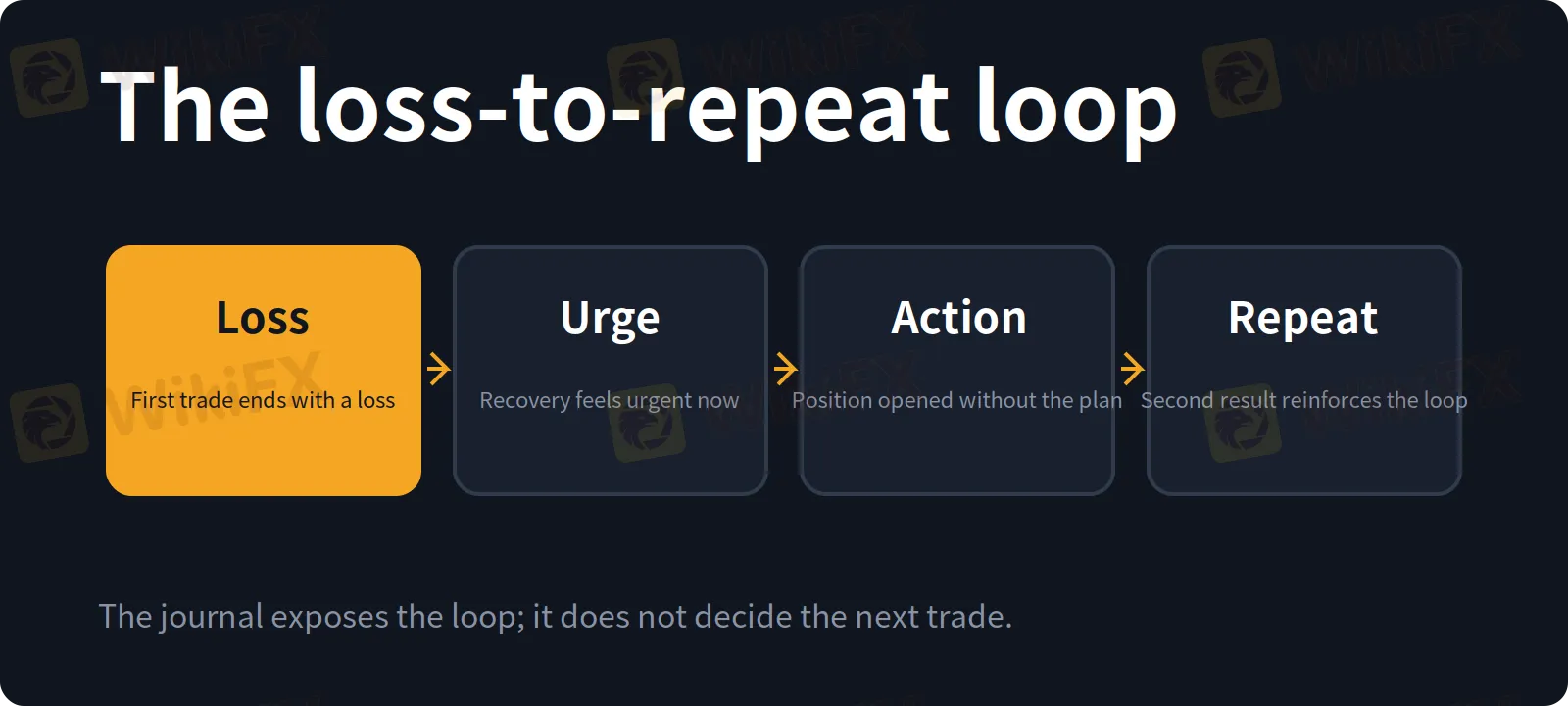
A common behavioural loop a journal can make visible.
Look for Repeats, Not Single Events
One bad trade is an event. Ten similar trades with the same emotion or trigger are a repeat. Patterns become visible when you sort the journal by more than profit.
- Sort by emotional state and look for the feeling that appears in your largest losses.
- Sort by time of day and see whether impatience clusters around a particular hour, without assuming one time is naturally better.
- Sort by what happened after a win and check whether a win makes you increase the amount you risk on the next trade.
- Sort by rule breaking and write down what was true just before you broke the rule.
Back to Mei: eight of her ten losing trades carry the word 'anxious' in the state column. That repeat is more informative than any single entry price. She can now watch for that feeling before deciding anything, instead of searching for a better setup on the chart. She still needs to decide for herself what to do with that information; the journal only makes the loop visible.
What Beginners Get Wrong
The biggest misunderstanding is that a journal is for accountability. It is mainly a mirror. A mirror does not punish; it reflects. Another mistake is waiting for a clear pattern before writing. Patterns rarely appear on the first page; they appear after you have enough entries to compare. You may notice a repeat after twenty or thirty trades, but there is no magic number. What matters is consistency.
The final mistake is turning self-observation into a second source of stress. If every loss requires a long paragraph, you will start avoiding the journal. Keep it short enough that you will actually fill it in. The goal is not to predict the market. The goal is to know which internal state usually precedes your choices. Once you can see the loop, you have a better chance of asking whether the decision is yours or just a repeat.
Disclaimer:
The views in this article only represent the author's personal views, and do not constitute investment advice on this platform. This platform does not guarantee the accuracy, completeness and timeliness of the information in the article, and will not be liable for any loss caused by the use of or reliance on the information in the article.
WikiFX Broker
Latest News
WikiFX Wishes You a Blessed Maulidur Rasul
WikiFXRev One Trading Shuts Down as Founder Shifts Focus to Prediction Markets
WikiFXHe Worked Hard and Saved Money Frugally, Now A Scammer Took It All
WikiFXForex trading psychology: why old prices stick in your mind
WikiFXWhat Your Trading Journal Really Reveals About Your Behaviour
WikiFXEMIRAX MARKETS Review: Withdrawal Blocks, Suspended Login Access, and a High-Risk Broker Warning
WikiFXLove Scams Now Use AI to Steal Your Heart and Savings
WikiFXUnemployed Man Loses RM516,000 Life Savings to Fake Online Investment Scam
WikiFXBrokers Expand As Prop Models Shift
WikiFXYour Trading Journal is a Mirror: How to Spot Behaviour Patterns
WikiFX